ICS
153
Computer
Networking Project
Due: 28 JUL 03
Instructions:
There are four projects to choose from. Pick one of the four projects. Three of the projects are designed to simulate real world situations in different career fields of computer networking. The fourth project is a term paper. The three career fields represented are Computer Consultant, Computer Network Manager, and Computer Network Programmer.
All projects are group projects with the exception of Project 4. Each group will contain 4-5 members. Each group is required to turn in a type written copy of their project. On your cover sheet be sure to indicate all group members’ names and ID numbers. Additional material may be required on some projects. Any additionally required material will be indicated in the project’s specific instructions. Choose only one project. No extra credit will be given for doing multiple projects.
The project is worth 50 points. That correlates to almost 1/7th of
the class grade. Bring the project to class on 28 JUL 03 and turn it in
directly to the instructor. You may pick
up your project at the
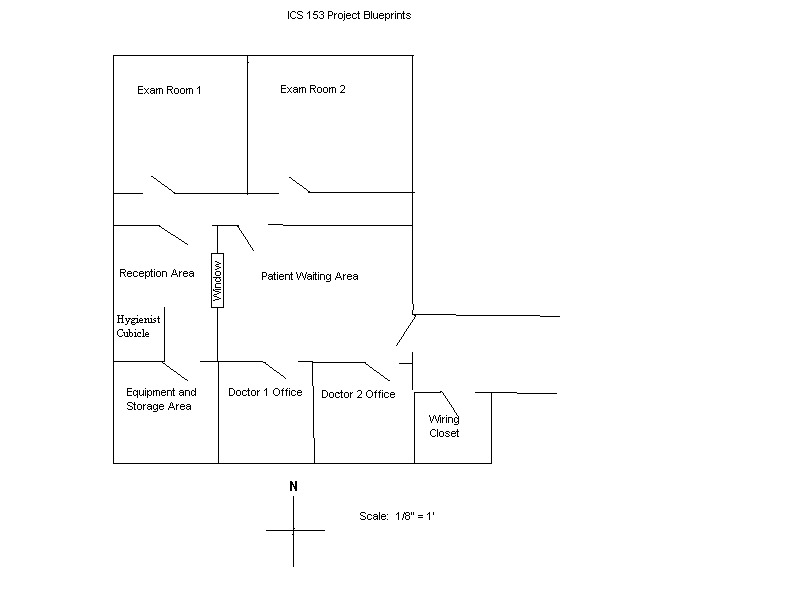
You are required to turn in the blueprints and a type written proposal of your network design to include estimates of your costs and charges. Defend in writing, your choices of product vendors, hardware, software, materials, equipment, locations of materials and equipment, and costs. On the blueprints indicate locations of materials and equipment.
Your written portion should contain two parts: A student portion and a bid portion. The student portion should contain specifics such as total cost, material sources, and any difficulties with the project. The bid portion should look like a bid for this contract with costs and a timeline.
On the blueprints note the following:
1) Walls are standard drywall. They are 8' tall and will accommodate voice/data outlets.
2) The ceilings are standard drop ceilings and will accommodate cable runs.
Project 1:
As President and CEO of your Network Consulting firm, you have been asked to bid on a network installation project. The project consists of providing a turnkey voice and data solution to a small but growing Dental Office. The office consists of two dentists with separate offices, one hygienist with a cubicle, one intake clerk and one secretary sharing a common area. See the blueprints for details.
The requirements are to provide all equipment necessary for telecommunications, word processing, internet access for email and web browsing, and a RDBMS for patient record storage. Each user will require one phone and one computer terminal. Blueprints are available at: http://www.ics.uci.edu/~cbdaviso/ics153/sum03/bluepr.bmp
The project will be graded using the following criteria: scalability, functionality, cost/value, and thoroughness.
You are required to turn in a type written report of your findings to include all findings, timings, and other appropriate observations. Defend in writing your metrics and your observations. Do not just report what you find but explain why it is that way.
Project 2:
Utilizing the 3rd floor ICS 153 lab , you are required to run network timing metrics using the ping utility. You will be testing the network performance of large vs. small data packets on switched vs. shared Ethernet. You will be testing the network performance of large vs. small data packets on shared coax vs. twisted pair cable. You will be testing network performance under light and heavy load conditions. It is important to note the switch and hub counters are cumulative, and will need to be cleared before your experiments begin.
The network load does not change so time of day and load conditions are not relevant. Sample size should be a judgement call. What do you think is a good sample size to determine network performance? Refer to Chapter 6, section 6 in the Tanenbaum text.
The following user id and passwords are important:
Allied Telesyn, Ethernet Switch: no user id or password is required, just hit enter twice to get to the menu system.
Allied Telesyn Ethernet hub: no user id or password is required, just hit enter twice to get to the menu system.
Unix workstations: uid: root, p-word: ics153 (This is the root login: DO NOT abuse the privilege)
The following list of IP addresses are important:
10.0.0.5 – Allied Telesyn IEEE 802.3 hub
10.0.0.6 -- Allied Telesyn IEEE 802.3 switch
10.0.0.1 – pc1 (Unix workstation)
10.0.0.2 – pc2 (Unix workstation)
10.0.0.3 – pc3 (Unix workstation)
10.0.0.4 – pc4 (Unix workstation)
Use ping (smallest packet size) on shared Ethernet to perform the following tests:
Ping one workstation from itself. What happens, how fast, and why?
Ping one workstation from the other. What happens, how fast, and why?
Ping two workstations from each other. What happens, how fast, and why?
Ping three workstations from each other. What happens, how fast, and why?
Ping all four workstations simultaneously from each other
(Workstation 1 à Workstation 2à Workstation 3àWorkstation 4à Workstation 1).
What happens, how fast, and why?
Now have all the workstations ping the hub. What happens, how fast and why?
Report the statistics the hub is recording as well. Be sure to reset its counters prior to your experiments.
Repeat the above tests with medium and then maximum packet size.
Change the shared Ethernet to switched Ethernet and repeat all tests. Additionally repeat all tests but ping the switch itself instead. Report the statistics the switch is recording as well. Be sure to reset its counters prior to your experiments.
The project will be graded using the following criteria: thoroughness, accuracy, and defense of results.
You will be required to email your executable program to your TA.
You will turn into class a printed copy of your source code, a screen-print prior to program execution and a screen-print during execution. Any program errors, enhancements, etc. should be reported in your project paper.
Project 3:
You are required to port a C program (source code provided at: http://www.ics.uci.edu/~cbdaviso/ics153/sum03/ping.c ) written for a unix platform to a GUI Windows NT platform. The program is the ping network utility. You are required to support all current ping options and you may make any enhancements that you desire. Options should have appropriate pull-down menus, input boxes, etc. Additionally, all fields should be error checked, required fields should be validated, etc.
The project will be graded using the following criteria: functionality, aesthetics, usability, and coding style.
You will be required to turn in 5-6 pages of type written, double-spaced, MLA or APA formatted research paper. Cover sheet and works cited (references) pages are not counted as part of the 5-6 pages of the research paper.
Project 4:
You are required to research any area of new and emerging networking technology. Have at least 5 sources and make sure to cite them properly. Submit your topic proposal to cbdaviso@uci.edu by 18 JUL 03.
The project will be graded using the following criteria: thoroughness, accuracy, and writing style.