Instruction-set architecture (ISA)&Register-transfer level (RTL)
Instruction-set architecture is “… the attributes of a computing system as seen by the programmer, i.e. the conceptual structure and functional behavior, as distinct from the organization of the data flows and controls the logic design, and physical implementation.” (Amdahl, Blaaw, and Brooks, 1964)
In another word, ISA is a kind of contract: programmers use the ISA to model how program will execute; hardware implementations use the ISA as a formal definition of the correct way to execute program.
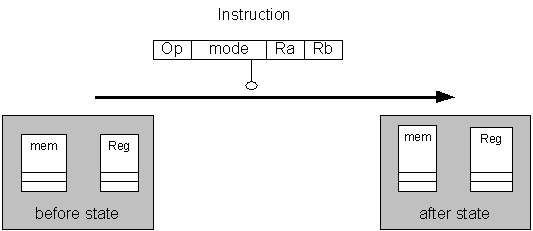
At a glance, instruction function on machine state (stored at memory and register file) change machine from one state into another.
Figure 1. ISA at a glance
The register-transfer level approach is characterized by: a digital system is viewed as divided into a data subsystem and a control subsystem; the state of the data subsystem consists of the contents of the registers; the function of the system is performed as a sequence of register transfers; a register transfer is a transformation performed on the datum while the datum is transferred from one register to another; the sequence of register transfers is controlled by the control subsystem.

Figure 2. Abstract view of RTL
Note: The distinction between ISA level and RTL is blurred, so some researchers believe they all belong to computer architecture scope.
1.Open source resources
1).Icarus Verilog is a Verilog simulation and synthesis tool. It operates as a compiler, compiling source code writen in Verilog (IEEE-1364) into some target format. For batch simulation, the compiler can generate an intermediate form called vvp assembly. This intermediate form is executed by the ``vvp'' command. For synthesis, the compiler generates netlists in the desired format. http://www.icarus.com/eda/verilog/
2.Web pages
Refer to the following link, we have detail picture of RTL&ISA:
http://www-cad.eecs.berkeley.edu/~keutzer/290-a/rtl-overviewa/sld002.htm
3.Citations
Standard textbooks on this level are: <<Computer Organization & Design: The Hardware/Software Interface>> and <<Computer Architecture: A Quantitative Approach>>.