
Euler's Formula, Proof 1: Interdigitating Trees
For any connected embedded planar graph \(G\) define the dual graph \(G^*\) by drawing a vertex in the middle of each face of \(G\), and connecting the vertices from two adjacent faces by a curve \(e^*\) through their shared edge \(e\). Note that \(G^{**}=G\). Any cycle in \(G\) disconnects \(G^*\) by the Jordan curve theorem. Any acyclic subgraph \(F\) of \(G\) is a forest and does not disconnect \(G^*\) (you can get from any face to any other face by detouring around trees in \(F\)). So connectedness and acyclicity are dual to each other. This duality forms the basis of the following proof:
Choose any spanning tree \(T\) in \(G\); this is by definition a connected acyclic subgraph. The dual edges of its complement, \((G\setminus T)^*\), form an acyclic connected subgraph of \(G^*\) which is therefore also a spanning tree. The two trees together have \((V-1)+(F-1)\) edges.
This is my favorite proof, and is the one I use when teaching graph theory. Sommerville attributes it to Von Staudt. It fits in well with other topics of planar duality such as the fact that every planar graph with all faces even is bipartite (by duality from Euler tours). Several other proofs of the Euler formula have two versions, one in the original graph and one in its dual, but this proof is self-dual as is the Euler formula itself.
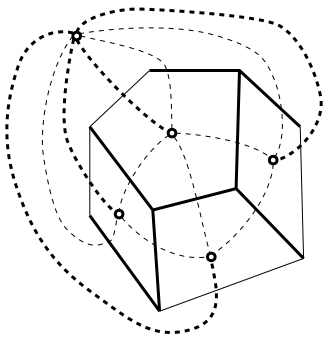
The idea of decomposing a graph into interdigitating trees has proven useful in a number of algorithms, including work of myself and others on dynamic minimum spanning trees as well as work of Goodrich and Tamassia on point location. It also has obvious connections to power-ground routing in VLSI design and to watershed analysis.