All Topics
This page collects in one place all the entries in the geometry junkyard.
Acme Klein Bottle. A topologist's delight, handcrafted in glass.
Acute square triangulation. Can one partition the square into triangles with all angles acute? How many triangles are needed, and what is the best angle bound possible?
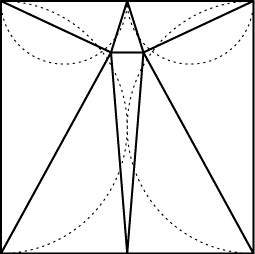
Adventitious geometry. Quadrilaterals in which the sides and diagonals form more rational angles with each other than one might expect. Dave Rusin's known math pages include another article on the same problem.
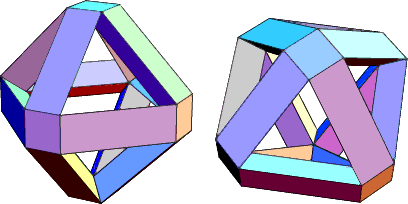
Adventures among the toroids. Reference to a book on polyhedral tori by B. M. Stewart.
The Aesthetics of Symmetry, essay and design tips by Jeff Chapman.
1st and 2nd Ajima-Malfatti points. How to pack three circles in a triangle so they each touch the other two and two triangle sides. This problem has a curious history, described in Wells' Penguin Dictionary of Curious and Interesting Geometry: Malfatti's original (1803) question was to carve three columns out of a prism-shaped block of marble with as little wasted stone as possible, but it wasn't until 1967 that it was shown that these three mutually tangent circles are never the right answer. See also this Cabri geometry page, the MathWorld Malfatti circles page, and the Wikipedia Malfatti circles page.
Algorithmic mathematical art, Xah Lee.
Algorithmic packings compared. Anton Sherwood looks at deterministic rules for disk-packing on spheres.
Algorithmic vectorial geometry, French geometry e-textbook by J.-P. Jurzak.
Are all triangles isosceles? A fallacious proof from K. S. Brown's math pages.
Ancient Islamic Penrose Tiles. Peter Lu uncovers evidence that the architects of a 500-year-old Iranian shrine used Penrose tiling to lay out the decorative patterns on its archways. From Ivars Peterson's MathTrek.
Angle trisection, from the geometry forum archives.
Animated proof of the Pythagorean theorem, M. D. Meyerson, US Naval Academy.
Escher-inspired animorphic art by Kelly Houle, including "impossible figures" such as linked Penrose tribars.
Anna's pentomino page. Anna Gardberg makes pentominoes out of sculpey and agate.
Antipodes. Jim Propp asks whether the two farthest apart points, as measured by surface distance, on a symmetric convex body must be opposite each other on the body. Apparently this is open even for rectangular boxes.
Anton's modest little gallery of ray-traced 3d math.
Aperiodic colored tilings, F. Gähler. Also available in postscript.
Aperiodic tiling and Penrose tiles, Steve Edwards.
An aperiodic set of Wang cubes, J. UCS 1:10 (1995). Culik and Kari describe how to increase the dimension of sets of aperiodic tilings, turning a 13-square set of tiles into a 21-cube set.
Aperiodic space-filling tiles: John Conway describes a way of glueing two prisms together to form a shape that tiles space only aperiodically. Ludwig Danzer speaks at NYU on various aperiodic 3d tilings including Conway's biprism.
Apollonian Gasket, a fractal circle packing formed by packing smaller circles into each triangular gap formed by three larger circles. From MathWorld.
Applications of shapes of constant width. A Reuleaux triangle doesn't quite drill out a square hole (it leaves rounded corners) but a different and less-symmetric constant-width shape based on an isosceles right triangle can be used to do so. This web page also discusses coin design, cams, and rotary engines, all based on curves of constant width; see also discussion on Metafilter.
Arc length surprise. The sum of the areas of the regions between a circular arc and the x-axis, and between the arc and the y-axis, does not depend on the position of the arc! From Mudd Math Fun Facts.
Archimedean solids: John Conway describes some interesting maps among the Archimedean polytopes. Eric Weisstein lists properties and pictures of the Archimedean solids.
Are most manifolds hyperbolic? From Dave Rusin's known math pages.
Area of hyperbolic triangles. From the Geometry Center's Java gallery of interactive geometry.
Area of the Mandelbrot set. One can upper bound this area by filling the area around the set by disks, or lower bound it by counting pixels; strangely, Stan Isaacs notes, these two methods do not seem to give the same answer.
Arranging six squares. This Geometry Forum problem of the week asks for the number of different hexominoes, and for how many of them can be folded into a cube.
Art, Math, and Computers -- New Ways of Creating Pleasing Shapes, C. Séquin, Educator's TECH Exchange, Jan. 1996.
The Art and Science of Tiling. Penrose tiles at Carleton College.
Art at the 2005 Joint Mathematics Meetings, including many geometric models.
Art of the Tetrahedron. And by "Art" he means "Arthur". Arthur Silverman's geometric sculpture, from Ivars Peterson's MathTrek.
ASCII Menger sponge, W. Taylor.
Associahedron and Permutahedron. The associahedron represents the set of triangulations of a hexagon, with edges representing flips; the permutahedron represents the set of permutations of four objects, with edges representing swaps. This strangely asymmetric view of the associahedron (as an animated gif) shows that it has some kind of geometric relation with the permutahedron: it can be formed by cutting the permutahedron on two planes. A more symmetric view is below. See also a more detailed description of the associahedron and Jean-Louis Loday's paper on associahedron coordinates.

Associating the symmetry of the Platonic solids with polymorf manipulatives.
Astro-Logix 3d ball-and-stick geometric construction kit.
The Atomium, structure formed for Expo 1958 in the form of nine spheres, representing an iron crystal. The world's largest cube?
Atlas of oriented knots and links, Corinne Cerf extends previous lists of all small knots and links, to allow each component of the link to be marked by an orientation.
On the average height of jute crops in the month of September. Vijay Raghavan points out an obscure reference to average case analysis of the Euclidean traveling salesman problem.
David Bailey's world of tesselations. Primarily consists of Escher-like drawings but also includes an interesting section about Kepler's work on polyhedra.
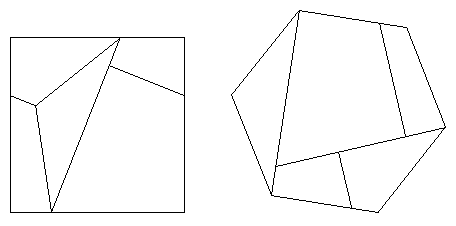
Henry Baker's hypertext version of HAKMEM includes a dissection of square and hexagon, depicted below.
Balanced ternary reptiles, Cantor's hourglass reptile, spiral reptile, stretchtiles, trisection of India, the three Bodhi problem, and other Fractal tilings by R. W. Gosper.
Basic crystallography diagrams, B. C. Taverner, Witwatersrand.
Beezer's PlayDome. Rob Beezer makes truncated icosahedra out of old automobile tires.
The bellows conjecture, R. Connelly, I. Sabitov and A. Walz in Contributions to Algebra and Geometry , volume 38 (1997), No.1, 1-10. Connelly had previously discovered non-convex polyhedra which are flexible (can move through a continuous family of shapes without bending or otherwise deforming any faces); these authors prove that in any such example, the volume remains constant throughout the flexing motion.
Belousov's Brew. A recipe for making spiraling patterns in chemical reactions.
Bending a soccer ball mathematically. Michael Trott animates morphs between a torus and a double-covered sphere, to illustrate their topological equivalence, together with several related animations.
Beyond the Möbius strip. Construction templates for paper models of Möbius-related three-dimensional surfaces.
BitArt spirolateral gallery (requires JavaScript to view large images, and Java to view self-running demo or construct new spirolaterals).
Blocking polyominos. R. M. Kurchan asks, for each k, what is the smallest polyomino such that k copies can form a "blocked" configuration in which no piece can be slid free of the others, but in which any subconfiguration is not blocked.
Books on polyhedra and polytopes. Collected by Tony Davie, St. Andrews U. For a more thorough listing see Wikipedia's list of books about polyhedra.
Border pattern gallery. Oklahoma State U. class project displaying examples of the seven types of symmetry (frieze groups) possible for linear patterns in the plane.
Borromean rings don't exist. Geoff Mess relates a proof that the Borromean ring configuration (in which three loops are tangled together but no pair is linked) can not be formed out of circles. Dan Asimov discusses some related higher dimensional questions. Matthew Cook conjectures the converse.

Are Borromean links so rare? S. Javan relates the history of the links and describes various generalizations with more than three rings. For more history and symbolism of the Borromean rings, see Peter Cromwell's web site.
Bounded degree triangulation. Pankaj Agarwal and Sandeep Sen ask for triangulations of convex polytopes in which the vertex or edge degree is bounded by a constant or polylog.
Box in a box. What is the smallest cube that can be put inside another cube touching all its faces? There is a simple solution, but it seems difficult to prove its correctness. The solution and proof are even prettier in four dimensions.
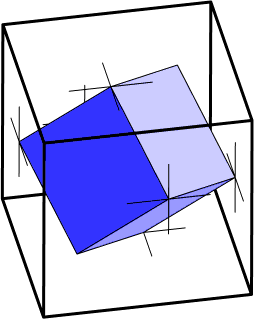
Boy's surface on Wikipedia, Boy's surface on MathWorld, Boy's surface at the Geometry Center, and an asymmetric animated gif from the Harvard zoo.
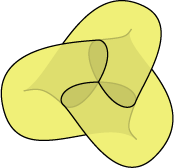
Brahmagupta's formula. A "Heron-type" formula for the maximum area of a quadrilateral, Col. Sicherman's fave. He asks if it has higher-dimensional generalizations.
Breaking Bonds. Geometric sculpture by Stephen Luecking combining buckyball, hexagon, and amorphous shapes of carbon molecules.
A Brunnian link. Cutting any one of five links allows the remaining four to be disconnected from each other, so this is in some sense a generalization of the Borromean rings. However since each pair of links crosses four times, it can't be drawn with circles.
Buckyballs. The truncated icosahedron recently acquired new fame and a new name when chemists discovered that Carbon forms molecules with its shape.
Buffon's needle. What is the probability that a dropped needle lands on a crack on a hardwood floor? From Kunkel's mathematics lessons.
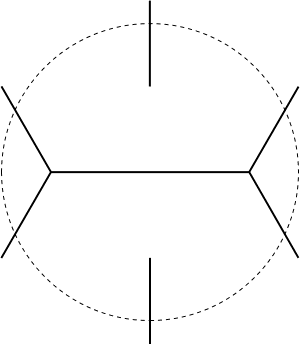
Building a better beam detector. This is a set that intersects all lines through the unit disk. The construction below achieves total length approximately 5.1547, but better bounds were previously known.
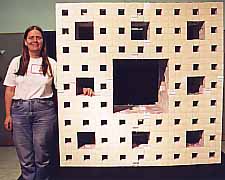
The business card Menger sponge project. Jeannine Mosely wants to build a fractal cube out of 66048 business cards. The MIT Origami Club has already made a smaller version of the same shape.
Oliver Byrne's 1847 edition of Euclid, put online by UBC. "The first six books of the Elements of Euclid, in which coloured diagrams and symbols are used instead of letters for the greater ease of learners."
Calabi's triangle constant, defining the unique non-equilateral triangle with three equally large inscribed squares. Is there a three-dimensional analogue? From MathSoft's favorite constants pages.
Canonical polygons. Ronald Kyrmse investigates grid polygons in which all side lengths are one or sqrt(2).
Cardahedra. Business card polyhedral origami.
Carnival triangles. A factoid about similar triangles inspired by a trigonometric identity.
Catalogue of lattices, N. J. A. Sloane, AT&T Labs Research. See also Sloane's sphere-packing and lattice theory publications.
Cellular automaton run on Penrose tiles, D. Griffeath. See also Eric Weeks' page on cellular automata over quasicrystals.
Centers of maximum matchings. Andy Fingerhut asks, given a maximum (not minimum) matching of six points in the Euclidean plane, whether there is a center point close to all matched edges (within distance a constant times the length of the edge). If so, it could be extended to more points via Helly's theorem. Apparently this is related to communication network design. I include a response I sent with a proof (of a constant worse than the one he wanted, but generalizing as well to bipartite matching).
Chaotic tiling of two kinds of equilateral pentagon, with 30degree symmetry, Ed Pegg Jr.
The charged particle model: polytopes and optimal packing of p points in n dimensional spheres.
The Cheng-Pleijel point. Given a closed plane curve and a height H, this point is the apex of the minimum surface area cone of height H over the curve. Ben Cheng demonstrates this concept with the help of a Java applet.
The chromatic number of the plane. Gordon Royle and Ilan Vardi summarize what's known about the famous open problem of how many colors are needed to color the plane so that no two points at a unit distance apart get the same color. See also another article from Dave Rusin's known math pages.
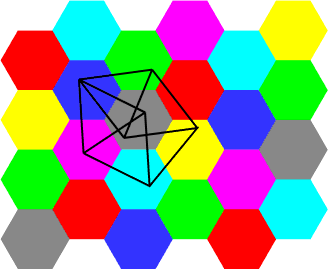
Cinderella multiplatform Java system for compass-and-straightedge construction, dynamic geometry demonstrations and automatic theorem proving. Ulli Kortenkamp and Jürgen Richter-Gebert, ETH Zurich.
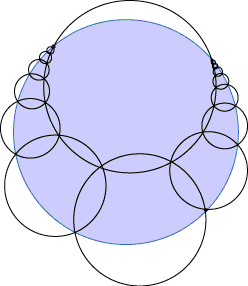
Circle fractal based on repeated placement of two equal tangent circles within each circle of the figure. One could also get something like this by inversion, starting with three mutually tangent circles, but then the circles at each level of the recursion wouldn't all stay the same size as each other.
Circle packing and discrete complex analysis. Research by Ken Stephenson including pictures, a bibliography, and downloadable circle packing software.
Circle packings. Gareth McCaughan describes the connection between collections of tangent circles and conformal mapping. Includes some pretty postscript packing pictures.
Circles in ellipses. James Buddenhagen asks for the smallest ellipse that contains two disjoint unit circles. Discussion continued in a thread on three circles in an ellipse.
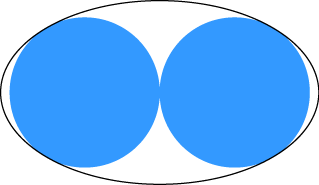
Circular coverage constants. How big must N equal disks be in order to completely cover the unit disk? What about disks with sizes in geometric progression? From MathSoft's favorite constants pages.
Circular quadrilaterals. Bill Taylor notes that if one connects the opposite midpoints of a partition of the circle into four chords, the two line segments you get are at right angles. Geoff Bailey supplies an elegant proof.
Circumcenters of triangles. Joe O'Rourke, Dave Watson, and William Flis compare formulas for computing the coordinates of a circle's center from three boundary points, and higher dimensional generalizations.
Circumference/perimeter of an ellipse: formula(s). Interesting and detailed survey of formulas giving accurate approximations to this value, which can not be expressed exactly as a closed form formula.
Circumnavigating a cube and a tetrahedron, Henry Bottomley.
Clusters and decagons, new rules for using overlapping shapes to construct Penrose tilings. Ivars Peterson, Science News, Oct. 1996.
Collinear points on knots. Greg Kuperberg shows that a non-trivial knot or link in R3 necessarily has four colinear points.
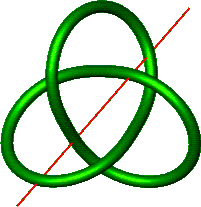
Coloring line arrangements. The graphs formed by overlaying a collection of lines require three, four, or five colors, depending on whether one allows three or more lines to meet at a point, and whether the lines are considered to wrap around through infinity. Stan Wagon asks similar questions for unit circle arrangements.
Common misconception regarding a cube, Paul Bourke. No, the Egyptian pyramids were not formed by dropped giant cubes from space.
Complex polytope. A diagram representing a complex polytope, from H. S. M. Coxeter's home page.
Complex regular tesselations on the Euclid plane, Hironori Sakamoto.
Complexification Gallery of Computation. Some kind of algorithmic art; I'm not sure what algorithms were used to produce it but the results are pretty.
a computational approach to tilings. Daniel Huson investigates the combinatorics of periodic tilings in two and three dimensions, including a classification of the tilings by shapes topologically equivalent to the five Platonic solids.
Computer art inspired by M. C. Escher and V. Vasarely, H. Kuiper.
Conceptual proof that inversion sends circles to circles, G. Kuperberg.
Connect the dots. Ed Pegg asks how many sides are needed in a (self-crossing) polygon, that passes through every point of an n*n grid. I added a similar puzzle with circular arcs.
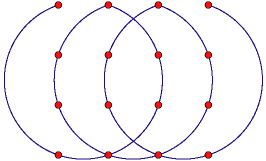
constant-width shapes and Reuleaux triangle from Eric Weisstein's treasure trove.
Constructing Boy's surface out of paper and tape.
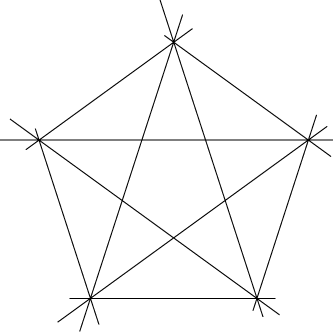
Constructing a regular pentagon inscribed in a circle, by straightedge and compass. Scott Brodie.
Contortion Engineering. Some Escher-like impossible figures from Offworld Press.
Contour plots with trig functions. Eric Weeks discovers a method of making interesting non-moiré patterns.
Convex Archimedean polychoremata, 4-dimensional analogues of the semiregular solids, described by Coxeter-Dynkin diagrams representing their symmetry groups.
A Counterexample to Borsuk's Conjecture, J. Kahn and G. Kalai, Bull. AMS 29 (1993). Partitioning certain high-dimensional polytopes into pieces with smaller diameter requires a number of pieces exponential in the dimension.
Counting polyforms, with links to images of various packing-puzzle solutions.
Covering the Aztec diamond with one-sided tetrasticks, A. Wassermann.
Covering points by rectangles. Stan Shebs discusses the problem of finding a minimum number of copies of a given rectangle that will cover all points in some set, and mentions an application to a computer strategy game. This is NP-hard, but I don't know how easy it is to approximate; most related work I know of is on optimizing the rectangle size for a cover by a fixed number of rectangles.
Cranes, planes, and cuckoo clocks. Announcement for a talk on mathematical origami by Robert Lang.
Crocheted Seifert surfaces by Matthew Wright. George Hart, Make Magazine.
Andrew Crompton. Grotesque geometry, Tessellations, Lifelike Tilings, Escher style drawings, Dissection Puzzles, Geometrical Graphics, Mathematical Art. Anamorphic Mirrors, Aperiodic tilings, Optical Machines.
Crop circles: theorems in wheat fields. Various hoaxers make geometric models by trampling plants.
Crystallographic topology. C. Johnson and M. Burnett of Oak Ridge National Lab use topological methods to understand and classify the symmetries of the lattice structures formed by crystals. (Somewhat technical.)
Crystallography now, tutorial on the seventeen plane symmetry groups by George Baloglou.
CSE logo. This java applet allows interactive control of a rotating collection of cubes.
Cube Dissection. How many smaller cubes can one divide a cube into? From Eric Weisstein's treasure trove of mathematics.
Cube triangulation. Can one divide a cube into congruent and disjoint tetrahedra? And without the congruence assumption, how many higher dimensional simplices are needed to triangulate a hypercube? For more on this last problem, see Triangulating an n-dimensional cube, S. Finch, MathSoft, and Asymptotically efficient triangulations of the d-cube, Orden and Santos.

The Curlicue Fractal, Fergus C. Murray.
Curvature of crossing convex curves. Oded Schramm considers two smooth convex planar curves crossing at at least three points, and claims that the minimum curvature of one is at most the maximum curvature of the other. Apparently this is related to conformal mapping. He asks for prior appearances of this problem in the literature.
Curvature of knots. Steve Fenner proves the Fary-Milnor theorem that any smooth, simple, closed curve in 3-space must have total curvature at least 4 pi.
Cut-the-knot logo. With a proof of the origami-folklore that this folded-flat overhand knot forms a regular pentagon.
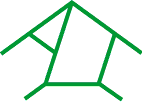
Dancing links. Don Knuth discusses implementation details of polyomino search algorithms.
Deconstructing Marty. Tom Beard and Dorking Labs analyze the Sierpinski-carpet-like geometry of New Zealand fractal artist Martin Thompson's works.
Dehn invariants of hyperbolic tiles. The Dehn invariant is one way of testing whether a Euclidean polyhedron can be used to tile space. But as Doug Zare describes, there are hyperbolic tiles with nonzero Dehn invariant.
Delaunay and regular triangulations. Lecture by Herbert Edelsbrunner, transcribed by Pedro Ramos and Saugata Basu. The regular triangulation has been popularized by Herbert as the appropriate generalization of the Delaunay triangulation to collections of disks.
Delaunay triangulation and points of intersection of lines. Tom McGlynn asks whether the DT of a line arrangement's vertices must respect the lines; H. K. Ruud shows that the answer is no.
Delta Blocks. Hop David discusses ideas for manufacturing building blocks based on the tetrahedron-octahedron space tiling depicted in Escher's "Flatworms".
Deltahedra, polyhedra with equilateral triangle faces. From Eric Weisstein's treasure trove of mathematics.
Densest packings of equal spheres in a cube, Hugo Pfoertner. With nice ray-traced images of each packing. See also Martin Erren's applet for visualizing the sphere packings.
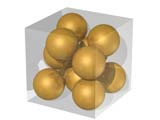
Dérivés de l'hexagone. Art by Jerome Pierre based on modifications to the edges in a hexagonal tiling of the plane.
Detecting the unknot in polynomial time, C. Delman and K. Wolcott, Eastern Illinois U.
DeVicci's Tesseract. Higher-dimensional generalizations of Prince Rupert's cube, from MathSoft's favorite constants pages.
Diamond theory. Steven Cullinane studies the symmetries of the shapes formed by splitting each square of a grid into dark and light triangles.
Dictionary of Combinatorics, Joe Fields, U. Illinois at Chicago.
Die-cast metal polyhedra available for sale from Pedagoguery Software.
Dilation-free planar graphs. How can you arrange n points so that the set of all lines between them forms a planar graph with no extra vertices?

Disjoint triangles. Any 3n points in the plane can be partitioned into n disjoint triangles. A. Bogomolny gives a simple proof and discusses some generalizations.
Dissection challenges. Joshua Bao asks for some dissections of squares into other figures.
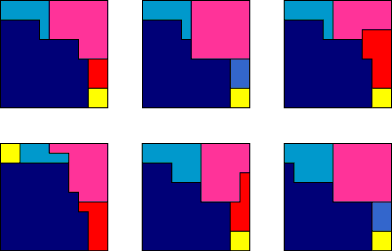
Dissection and dissection tiling. This page describes problems of partitioning polygons into pieces that can be rearranged to tile the plane. (With references to publications on dissection.)
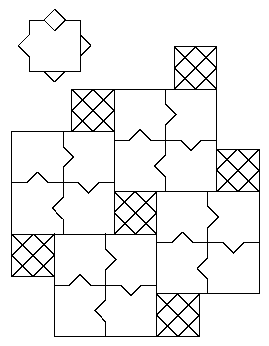
Dissection problem-of-the-month from the Geometry Forum. Cut squares and equilateral triangles into pieces and rearrange them to form each other or smaller copies of themselves.
A dissection puzzle. T. Sillke asks for dissections of two heptominoes into squares, and of a square into similar triangles.
Dissections. From Eric Weisstein's treasure trove of mathematics.
Dissections de polygones, réguliers ou non réguliers. Various polygon dissections, animated in CabriJava.
Dissections: Plane & Fancy, Greg Frederickson's dissection book. Greg also has a list of more links to geometric dissections on the web.
Distances on the surface of a rectangular box, illustrated using colored wavefronts in this Java applet by Henry Bottomley.
DNA, apocalypse, & the end of the mystery. A sacred-geometry analysis of "the geometric pattern of the heavenly city which is the template of the New Jerusalem".
Dodecafoam. A fractal froth of polyhedra fills space.
Dodecahedral melon and other fruit polyhedra, by Vi Hart.
Dodecahedron measures, Paul Kunkel.
Domegalomaniahedron. Clive Tooth makes polyhedra out of his deep and inscrutable singular name.
Sylvie Donmoyer geometry-inspired paintings including Menger sponges and a behind-the-scenes look at Escher's Stars.
Double bubbles. Joel Hass investigates shapes formed by soap films enclosing two separate regions of space.
The downstairs half bath. Bob Jenkins decorated his bathroom with ceramic and painted pentagonal tiles.
Dreamscope screen-saver module makes patterns with various Kaleidoscopic symmetries.
DUST software for visualization of Voronoi diagrams, Delaunay triangulations, minimum spanning trees, and matchings, U. Köln.
Dynamic formation of Poisson-Voronoi tiles. David Griffeath constructs Voronoi diagrams using cellular automata.
The Dynamic Systems and Technology Project at Boston Univ. offers several Java applets and animations of fractals and iterated function systems.
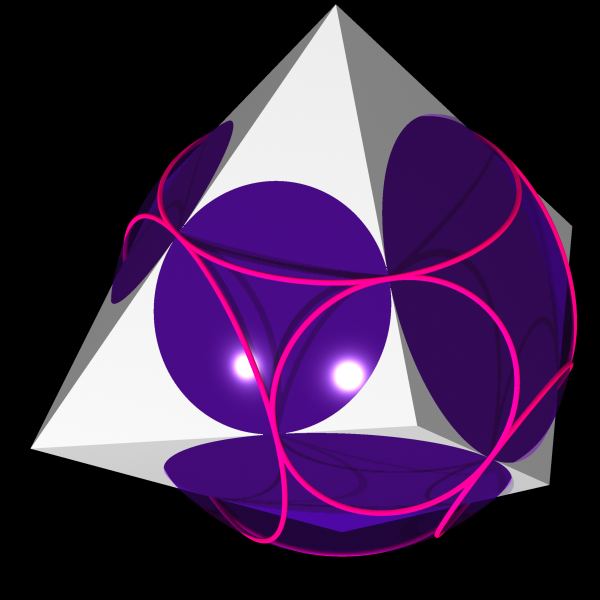
Edge-tangent polytope illustrating Koebe's theorem that any planar graph can be realized as the set of tangencies between circles on a sphere. Placing vertices at points having those circles as horizons forms a polytope with all edges tangent to the sphere. Rendered by POVray.
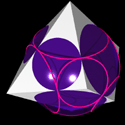
An eight-point arrangement in which each perpendicular bisector passes through two other points. From Stan Wagon's PotW archive.
Eight foxes. Daily geometry problems.
The 85 foldings of the Latin cross, E. Demaine et al.
Einstein's origami snowflake game. Rick Nordal challenges folders to make a sequence of geometric shapes with a single sheet of origami paper as quickly as possible.
Electronic Geometry Models, a refereed archive of interesting geometric examples and visualizations.
Elliptical billiard tables, H. Serras, Ghent.
Embedding the hyperbolic plane in higher dimensional Euclidean spaces. D. Rusin summarizes what's known; the existence of an isometric immersion into R4 is apparently open.
Enumeration of polygon triangulations and other combinatorial representations of the Catalan numbers.
Equiangular spiral. Properties of Bernoulli's logarithmic 'spiralis mirabilis'.
An equilateral dillemma. IBM asks you to prove that the only triangles that can be circumscribed around an equilateral triangle, with their vertices equidistant from the equilateral vertices, are themselves equilateral.
Equilateral pentagons. Jorge Luis Mireles Jasso investigates these polygons and dissects various polyominos into them.
Equilateral pentagons that tile the plane, Livio Zucca.
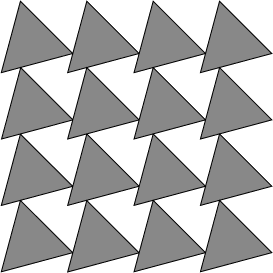
Equilateral triangles. Dan Asimov asks how large a triangle will fit into a square torus; equivalently, the densest packing of equilateral triangles in the pattern of a square lattice. There is only one parameter to optimize, the angle of the triangle to the lattice vectors; my answer is that the densest packing occurs when this angle is 15 or 45 degrees, shown below. (If the lattice doesn't have to be square, it is possible to get density 2/3; apparently this was long known, e.g. see Fáry, Bull. Soc. Math. France 78 (1950) 152.)
Asimov also asks for the smallest triangle that will always cover at least one point of the integer lattice, or equivalently a triangle such that no matter at what angle you place copies of it on an integer lattice, they always cover the plane; my guess is that the worst angle is parallel and 30 degrees to the lattice, giving a triangle with 2-unit sides and contradicting an earlier answer to Asimov's question.
The equivalence of two face-centered icosahedral tilings with respect to local derivability, J. Phys. A26 (1993) 1455. J. Roth dissects an aperiodic three-dimensional tiling involving zonohedra into another tiling involving tetrahedra and vice versa.
Equivalents of the parallel postulate. David Wilson quotes a book by George Martin, listing 26 axioms equivalent to Euclid's parallel postulate. See also Scott Brodie's proof of equivalence with the Pythagorean theorem.
Erich's Packing Page. Erich Friedman enjoys packing geometric shapes into other geometric shapes.
Escher for real and beyond Escher for real. Gershon Elber uses layered manufacturing systems to build 3d models of Escher's illusions. The trick is to make some seemingly-flat surfaces curve towards and away from the viewplane.
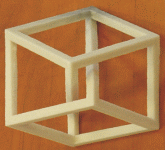
Escher and the Droste effect. Mathematical analysis of Escher's "Print Gallery".
Escher in the classroom, Jill Britton.
Escher in the Palace. The official web site of the Escher museum in The Hague.
Escher-like tilings of interlocking animal and human figures, by various artists.
Escher Fish. Silvio Levy's tessellation of the Poincare model of the hyperbolic plane by fish in M.C. Escher's style. From the Geometry Center archives.
Escher patterns, Yoshiaki Araki.
Escher's combinatorial patterns, D. Schattschneider, Elect. J. Combinatorics.
Escherization. How to find a periodic tile as close as possible to a given shape? Craig S. Kaplan, U. Washington.
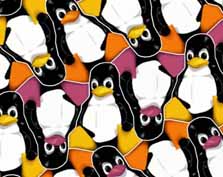
Eternity puzzle made from "polydrafters", compounds of 30-60-90 triangles. See also the mathpuzzle eternity page.
Euclid 3:16. Fun geometry T-shirt sighting, from Izzycat's blog. I want one.
Euclid's Elements, animated in Java by David Joyce. See also Ralph Abraham's extensively illustrated edition, and this manuscript excerpt from a copy in the Bodleian library made in the year 888.
Examples, Counterexamples, and Enumeration Results for Foldings and Unfoldings between Polygons and Polytopes, Erik D. Demaine, Martin L. Demaine, Anna Lubiw, Joseph O'Rourke, cs.CG/0007019.
Expansions geometric pattern creation techniques by John S. Stokes III.
Experiencing Geometry. A poem by David Henderson.
Explore the 120-cell! Free Windows+OpenGL+.Net software.
Exploring hyperspace with the geometric product. Thomas S. Briggs explains some four-dimensional shapes.
An extension of Napoleon's theorem. Placing similar isosceles triangles on the sides of an affine-transformed regular polygon results in a figure where the triangle vertices lie on another regular polygon. Geometer's sketchpad animation by John Berglund.
Fagnano's problem of inscribing a minimum-perimeter triangle within another triangle, animated in Java by A. Bogomolny. See also Fagnano part II, Fagnano part III, and a Fagnano reversed.
Fagnano's theorem. This involves differences of lengths in an ellipse. Joe Keane asks why it is unusual.
All the fair dice. Pictures of the polyhedra which can be used as dice, in that there is a symmetry taking any face to any other face.
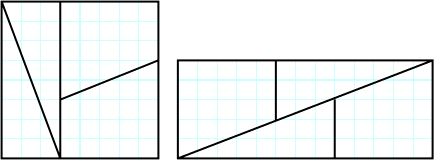
Fake dissection. An 8x8 (64 unit) square is cut into pieces which (seemingly) can be rearranged to form a 5x13 (65 unit) rectangle. Where did the extra unit come from? Jim Propp asks about possible three-dimensional generalizations. Greg Frederickson supplies one. See also Alexander Bogomolny's dissection of a 9x11 rectangle into a 10x10 square and Fibonacci bamboozlement applet.
Famous curve applet index. Over fifty well-known plane curves, animated as Java applets.
Chris Fearnley's 5 and 25 Frequency Geodesic Spheres rendered by POV-Ray.
Helaman Ferguson mathematical sculpture.
Fermat's spiral and the line between Yin and Yang. Taras Banakh, Oleg Verbitsky, and Yaroslav Vorobets argue that the ideal shape of the dividing line in a Yin-Yang symbol is formed, not from two semicircles, but from Fermat's spiral.
Michael Field's gallery of symmetric chaos images. See his home page for more links to pages on dynamics, symmetry, and chaos.
Figure eight knot / horoball diagram. Research of A. Edmonds into the symmetries of knots, relating them to something that looks like a packing of spheres. The MSRI Computing Group uses another horoball diagram as their logo.
Filling space with unit circles. Daniel Asimov asks what fraction of 3-dimensional space can be filled by a collection of disjoint unit circles. (It may not be obvious that this fraction is nonzero, but a standard construction allows one to construct a solid torus out of circles, and one can then pack tori to fill space, leaving some uncovered gaps between the tori.) The geometry center has information in several places on this problem, the best being an article describing a way of filling space by unit circles (discontinuously).
Find all polytopes. Koichi Hirata's web software for finding all ways of gluing the edges of a polygon so that it can fold into a convex polytope.
Finding the wood by the trees. Marc van Kreveld studies strategies by which a blind man with a rope could map out a forest.
Fisher Pavers. A convex heptagon and some squares produce an interesting four-way symmetric tiling system.
Ephraim Fithian's geometry web page. Teaching activities, test previews, and some Macintosh game software.
Five circle theorem. Karl Rubin and Noam Elkies asked for a proof that a certain construction leads to five cocircular points. This result was subsequently discovered by Allan Adler and Gerald Edgar to be essentially the same as a theorem proven in 1939 by F. Bath.
Five space-filling polyhedra. And not the ones you're likely thinking of, either. Guy Inchbald, reproduced from Math. Gazette 80, November 1996.
Five-fold symmetry in crystalline quasicrystal lattices, Donald L. D. Caspar and Eric Fontano.
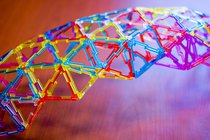
Flat equilateral tori. Can one build a polyhedral torus in which all faces are equilateral triangles and all vertices have six incident edges? Probably not but this physical model comes close.
The flat torus in the three-sphere. Thomas Banchoff animates the Hopf fibration.
Flexagons. Folded paper polyiamonds which can be "flexed" to show different sets of faces. See also Harold McIntosh's flexagon papers, including copies of the original 1962 Conrad-Hartline papers, also mirrored on Erik Demaine's website.
Flexible polyhedra. From Dave Rusin's known math pages.
Folding geometry. Wheaton college course project on modular origami.
The Four Color Theorem. A new proof by Robertson, Sanders, Seymour, and Thomas.
Four dice hypercube visualization.
The Fourth Dimension. John Savard provides a nice graphical explanation of the four-dimensional regular polytopes.
Four-dimensional visualization. Doug Zare gives some pointers on high-dimensional visualization including a description of an interesting chain of successively higher dimensional polytopes beginning with a triangular prism.
Fourier series of a gastropod. L. Zucca uses Fourier analysis to square the circle and to make an odd spiral-like shape.
The fractal art of Wolter Schraa. Includes some nice reptiles and sphere packings.
A fractal beta-skeleton with high dilation. Beta-skeletons are graphs used, among other applications, in predicting which pairs of cities should be connected by roads in a road network. But if you build your road network this way, it may take you a long time to get from point a to point b.
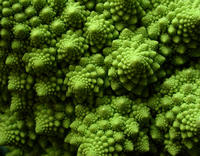
Fractal broccoli. Photo by alfredo matacotta. See also this French page.
Fractal fiber bundles. Troy Christensen ponders origami on the fabric folds of spacetime.
Fractal geometry and complex bases. Publications and software by W. Gilbert.
Fractal instances of the traveling salesman problem, P. Moscato, Buenos Aires.
Fractal knots, Robert Fathauer.
Fractal patterns formed by repeated inversion of circles: Indra's Pearls Inversion graphics gallery, Xah Lee. Inversive circles, W. Gilbert, Waterloo.
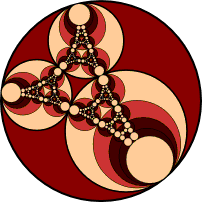
Fractal patterns in the real world, Ian Stewart.
Fractal planet and fractal landscapes. Felix Golubov makes random triangulated polyhedra in Java by perturbing the vertices of a recursive subdivision.
Fractal reptiles and other tilings by IFS attractors, Stewart Hinsley.
Fractal resources. A collection of web links by John Mathews.
Fractal skewed web. Sierpinski tetrahedron by Mary Ann Conners.
Fractals. The spanky fractal database at Canada's national meson research facility.
Fractals by da duke. Ray-traced Menger sponges and Sierpinski gaskets.
Fractiles, multicolored magnetic rhombs with angles based on multiples of pi/7.
Frequently asked questions about spheres. From Dave Rusin's known math pages.
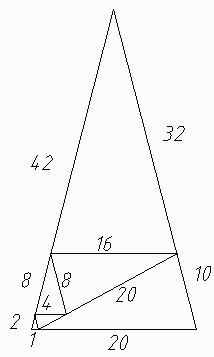
Erich Friedman's dissection puzzle. Partition a 21x42x42 isosceles triangles into six smaller triangles, all similar to the original but with no two equal sizes. (The link is to a drawing of the solution.)
Frustro, a font made of Escherian impossible figures.
Fun with Fractals and the Platonic Solids. Gayla Chandler places models of polyhedra and polyhedral fractals such as the Sierpinski tetrahedron in scenic outdoor settings and photographs them there.
Gallery of interactive on-line geometry. The Geometry Center's collection includes programs for generating Penrose tilings, making periodic drawings a la Escher in the Euclidean and hyperbolic planes, playing pinball in negatively curved spaces, viewing 3d objects, exploring the space of angle geometries, and visualizing Riemann surfaces.
Gaudí's geometric models. From the Gaudí museum in Parc Güell, Barcelona.
Gauss' tomb. The story that he asked for (and failed to get) a regular 17-gon carved on it leads to some discussion of 17-gon construction and perfectly scalene triangles.
Gaussian continued fractions. Stephen Fortescue discusses some connections between basic number-theoretic algorithms and the geometry of tilings of 2d and 3d hyperbolic spaces.
Gavrog, a Java package for visualizing 2d and 3d ornamental patterns with high degrees of symmetry.
Gecko Stone interlocking concrete pavers in geometric and animal shapes, designed by John August.
Geek bodyart. Geometric calculations for fitting your piercings.
Generating Fractals from Voronoi Diagrams, Ken Shirriff, Berkeley and Sun.
Geodesic dome design software. Now you too can generate triangulations of the sphere. Freeware for DOS, Mac, and Unix.
Geodesic math. Apparently this means links to pages about polyhedra.
Geometria Java-based software for constructing and measuring polyhedra by transforming and slicing predefined starting blocks.
Geometric Arts. Knots, fractals, tesselations, and op art. Formerly Quincy Kim's World of Geometry.
Geometric Dissections by Gavin Theobald.
Geometric graph coloring problems from "Graph Coloring Problems" by Jensen and Toft.

Geometric Java applets by Fergus C. Murray produce screensaver-like interactive images. See also his noninteractive mathematical animations and stills.
Geometric metaphors in literature, K. Kovaka.
Geometric probability question. What is the probability that the shortest paths between three random points on a projective plane form a contractible loop?
Geometric paper folding. David Huffman.
Geometric probability constants. From MathSoft's favorite constants pages.
A Geometrical Picturebook of finite and combinatorial geometries, B. Polster, to be published by Springer.
Géometriés non euclidiennes. Description of several models of the hyperbolic plane and some interesting hyperbolic constructions. From the Cabri geometry site. (In French.)
Geometrinity, geometric sculpture by Denny North.
Geometry of alphabets. Sacred geometry wackiness from the Library of Halexandria. Something about how the first verse of Genesis forms a dodecahedron, or a flower, or maybe a candlestick, somehow leading to squared circles, spiraling shofars, and circumscribed tetrahedra.
Geometry problems involving circles and triangles, with proofs. Antonio Gutierrez.
Geometry, algebra, and the analysis of polygons. Notes by M. Brundage on a talk by B. Grünbaum on vector spaces formed by planar n-gons under componentwise addition.
Geometry corner with Martin Gardner. He describes some problems of cutting polygons into similar and congruent parts. From the MAT 007 I News.
Geometry forum discussion on the Reuleux triangle and its ability to drill out (most of) a square hole.
Geometry and the Imagination in Minneapolis. Notes from a workshop led by Conway, Doyle, Gilman, and Thurston. Includes several sections on polyhedra, knots, and symmetry groups.
Geometry turned on -- making geometry dynamic. A book on the use of interactive software in teaching.
GeoProof interactive geometry software including automated theorem proving methods.
Ghost diagrams, Paul Harrison's software for finding tilings with Wang-tile-like hexagonal tiles, specified by matching rules on their edges. These systems are Turing-complete, so capable of forming all sorts of complex patterns; the web site shows binary circuitry, fractals, 1d cellular automaton simulation, Feynman diagrams, and more.
Glass dodecahedron. Custom-made for Clive Tooth by Bob Aurelius.
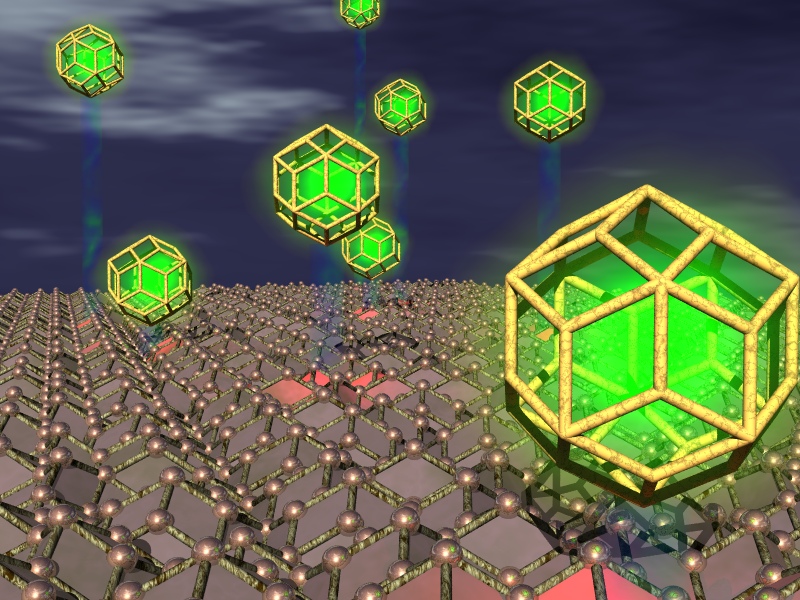
Glowing green rhombic triacontahedra in space. Rendered by Rob Wieringa for the May-June 1997 Internet Ray Tracing Competition.
The golden ratio in an equilateral triangle. If one inscribes a circle in an ideal hyperbolic triangle, its points of tangency form an equilateral triangle with side length 4 ln phi! One can then place horocycles centered on the ideal triangle's vertices and tangent to each side of the inner equilateral triangle. From the Cabri geometry site. (In French.)
The golden section and geometry. Somehow leading to questions like how many stars there are on the US flag.
Golden rectangles, Curtis McMullen.
A golden sales pitch. Julie Rehmeyer dissects the myth of the golden ratio in classical art and describes some new uses for it in commerce.
The golden section and Euclid's construction of the dodecahedron, and more on the dodecahedron and icosahedron, H. Serras, Ghent.
Golden spiral flash animation, Christian Stadler.
Goldene Schnittmuster. Article in German on Penrose tiling and related topics.
Golygons, polyominoes with consecutive integer side lengths. See also the Mathworld Golygon page.
Gömböc, a convex body in 3d with a single stable and a single unstable point of equilibrium. Placed on a flat surface, it always rights itself; it may not be a coincidence that some tortoise shells are similarly shaped. See also Gömböc on Wikipedia, Gömböc on Metafilter, and Gömböc in The New York Times.
Graham's hexagon, maximizing the ratio of area to diameter. You'd expect it to be a regular hexagon, right? Wrong. From MathSoft's favorite constants pages. See also Graham's Biggest Little Hexagon from MathWorld, and Wolfgang Schildbach's java animation of this hexagon and similar n-gons for larger values of n.
The Graph of the Truncated Icosahedron and the Last Letter of Galois, B. Kostant, Not. AMS, Sep. 1995. Group theoretic mathematics of buckyballs. See also J. Baez's review of Kostant's paper.
Graphite with growth spirals on the basal pinacoids. Pretty pictures of spirals in crystals. (A pinacoid, it turns out, is a plane parallel to two crystallographic axes.)
Great math programs. Xah Lee reviews mathematical software, focusing on educational Macintosh applications. Includes sections on geometric visualization, fractals, cellular automata, and geometric puzzles.
Great triambic icosidodecahedron quilt, made by Mark Newbold and Sarah Mylchreest with the aid of Mark's hyperspace star polytope slicer.
Greek mathematics and its modern heirs. Manuscripts of geometry texts by Euclid, Archimedes, and others, from the Vatican Library.
Melinda Green's geometry page. Green makes models of regular sponges (infinite non-convex generalizations of Platonic solids) out of plastic "Polydron" pieces.
Greg's favorite math party trick. A nice visual proof of van Aubel's theorem, that equal perpendicular line segments connect the opposite centers of squares exterior to the sides of any quadrilateral. See also van Aubel's theorem on Wikipedia, van Aubel's theorem on MathWorld, van Aubel's theorem in the land of the Incas, and an interactive Java van Aubel's theorem applet.
Grid subgraphs. Jan Kristian Haugland looks for sets of lattice points that induce graphs with high degree but no short cycles.
Rona Gurkewitz' Modular Origami Polyhedra Systems Page. With many nice images from two modular origami books by Gurkewitz, Simon, and Arnstein.
Hales, Honeybees, and Hexagons. Thomas Hales proves the optimality of bees' hexagonal honeycomb structure. Ivars Peterson, Science News Online.
Ham Sandwich Theorem: you can always cut your ham and two slices of bread each in half with one slice, even before putting them together into a sandwich. From Eric Weisstein's treasure trove of mathematics.
Bradford Hansen-Smith makes geometric art out of paper plates.
Happy cubes and other three-dimensional polyomino puzzles.
Happy Pentominoes, Vincent Goffin.
Harary's animal game. Chris Thompson asks about recent progress on this generalization of tic-tac-toe and go-moku in which players place stones attempting to form certain polyominoes.
Jean-Pierre Hébert - Studio. Algorithmic and geometric art site.
Hebesphenomegacorona
onna stickin space! Space Station Science picture of the day. In case you don't remember what a hebesphenomegacorona is, it's one of the Johnson solids: convex polyhedra with regular-polygon faces.Hecatohedra. John Conway discusses the possible symmetry groups of hundred-sided polyhedra.
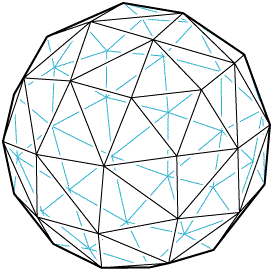
Hedronometry. Don McConnell discusses equations relating the angles and face areas of tetrahedra. See also McConnell's hedronometry site.
Helical geometry. Ok, renaming a hyperbolic paraboloid a "helical right triangle" and saying that it's "a revolutionary foundation for new knowledge" seems a little cranky but there are some interesting pictures of shapes formed by compounds of these saddles.
Hippias' Quadratrix, a curve discovered around 420-430BC, can be used to solve the classical Greek problems of squaring the circle, trisecting angles, and doubling the cube. Also described in St. Andrews famous curves index, Xah's special curve index, Eric Weisstein's treasure trove, and H. Serras' quadratrix page.
Heesch's problem. How many times can a shape be completely surrounded by copies of itself, without being able to tile the entire plane? W. R. Marshall and C. Mann have recently made significant progress on this problem using shapes formed by indenting and outdenting the edges of polyhexes.
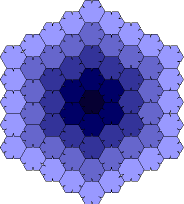
Heilbronn triangle constants. How can you place n points in a square so that all triangles formed by triples of points have large area?
Helical Gallery. Spirals in the work of M. C. Escher and in X-ray observations of the sun's corona.
Heptomino Packings. Clive Tooth shows us all 108 heptominos, packed into a 7x9x12 box.
Hermite's constants. Are certain values associated with dense lattice packings of spheres always rational? Part of Mathsoft's collection of mathematical constants.
Hero's Formula for the area of a triangle in terms of its side lengths. Mark Dominus explains.
High school buckyball art. Kerry Stefancyk, Allison Cahill, and Jessica Smith make polyhedral models out of stained glass.
Hilbert's 3rd Problem and Dehn Invariants. How to tell whether two polyhedra can be dissected into each other. See also Walter Neumann's paper connecting these ideas with problems of classifying manifolds.
Hinged dissections of polyominoes.

Hinged kite mirror dissection. General techniques for cutting any polygon into pieces that can be unfolded and refolded to form the polygon's mirror image.
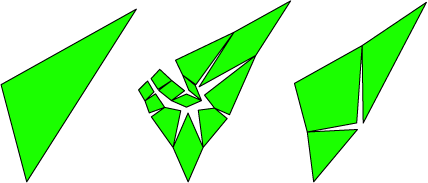
Holyhedra. Jade Vinson solves a question of John Conway on the existence of finite polyhedra all of whose faces have holes in them (the Menger sponge provides an infinite example).
Hopf fibration. R. Kreminski, the U. Sheffield maths dept., and MathWorld explain and animate the partition of a 3-sphere into circles.
Houtrust Relief. Nice photo of a 3d version of one of Escher's bird-fish textures, on the wall of a water purifying plant in The Netherlands. The same photographer has several other Escher photos including one of Metamorphoses in the Hague post office.
How many intersection points can you form from an n-line arrangement? Equivalently, how many opposite pairs of faces can an n-zone zonohedron have? It must be a number between n-1 and n(n-1)/2, but not all of those values are possible.
How many points can one find in three-dimensional space so that all triangles are equilateral or isosceles? One eight-point solution is formed by placing three points on the axis of a regular pentagon. This problem seems related to the fact that any planar point set forms O(n7/3) isosceles triangles; in three dimensions, Theta(n3) are possible (by generalizing the pentagon solution above). From Stan Wagon's PotW archive.
How to construct a golden rectangle, K. Wiedman.
How to fold a piece of paper in half twelve times. Britney Gallivan took on this previously-thought-impossible task as a high school science project, worked out an accurate mathematical model of the requirements, and used that model to complete the task.
How to write "computational geometry" in Japanese (or Chinese).
George Huttlin's Puzzle Page. Some ramblings in the world of polyominoes and hexiamonds.
Human Geometry and Naked Geometry. The human form as a building block of larger geometric figures, by Mike Naylor.
Hyacinthos triangle geometry mailing list.
HypArr, software for modeling and visualizing convex polyhedra and plane arrangements, now seems to be incorporated as a module in a larger Matlab library for multi-parametric analysis.
Hyperbolic crochet coral reef, the Institute for Figuring. Daina Taimina's technique for crocheting yarn into hyperbolic surfaces forms the basis for an exhibit of woolen undersea fauna and flora.
Hyperbolic games. Freeware multiplatform software for games such as Sudoku on hyperbolic surfaces, intended as a way for students to gain familiarity with hyperbolic geometry. By Jeff Weeks.
Hyperbolic geometry. Visualizations and animations including several pictures of hyperbolic tessellations.
Hyperbolic Knot. From Eric Weisstein's treasure trove of mathematics.
Hyperbolic packing of convex bodies. William Thurston answers a question of Greg Kuperberg, on whether there is a constant C such that every convex body in the hyperbolic plane can be packed with density C. The answer is no -- long skinny bodies can not be packed efficiently.
The HyperSphere, from an Artistic point of View, Rebecca Frankel.
Hyperbolic shortbread. The Davis math department eats a Poincaré model of a tiling of the hyperbolic plane by 0-60-90 triangles.
The hyperbolic surface activity page. Tom Holroyd describes hyperbolic surfaces occurring in nature, and explains how to make a paper model of a hyperbolic surface based on a tiling by heptagons.
Hyperbolic Tessellations, David Joyce, Clark U.
Hyperbolic tiles. John Conway answers a question of Doug Zare on the polyhedra that can form periodic tilings of 3-dimensional hyperbolic space.
Hyperbolic and spherical tiling gallery, Bernie Freidin.
Hyperbolic planar tessellations, image gallery of many regular and semiregular tilings by Don Hatch.
Hypercube's Home Page. Speculations on the fourth dimension collected by Eric Saltsman.
Hypercube fun. John Atkeson finds a nice recursive drawing pattern for high dimensional hypercubes in two dimensional planes.
Hypercube game. Experience the fourth dimension with an interactive, stereoscopic java animation of the hypercube.
Hypercube visualization, Drew Olbrich.
Hypercubes in hyper perspective. Red-blue 3d visualizations produced with the virtual flower system.
Hyperdimensional Java. Several web applets illustrating high-dimensional concepts, by Ishihama Yoshiaki.
HyperGami program for unfolding polyhedra, also described in this article from the American Scientist.
HyperGami gallery. Paper polyhedral penguins, pinapples, pigs, and more.
Hypergami polyhedral playground. Rotatable wireframe models of platonic solids and of the penguinhedron.
Hyperspace star polytope slicer, Java animation by Mark Newbold.
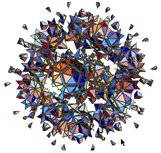
Hyperspace structures. Exploring the fourth dimension.
Hyperspheres. Eric Weisstein calculates volumes and surface areas of hyperspheres, which curiously reach a maximum for dimensions around 5.257 and 7.257 respectively.
Hyperspheres, hyperspace, and the fourth spatial dimension. M. R. Feltz views the universe as a closed cosmic hypersphere.
The icosahedron, the great icosahedron, graph designs, and Hadamard matrices. Notes by M. Brundage from a talk by M. Rosenfeld.
Icosamonohedra, icosahedra made from congruent but not necessarily equilateral triangles.
Ideal hyperbolic polyhedra ray-traced by Matthias Weber.
Images of geometry. From the geometry center graphics archives. More images, from "Interactive Methods for Visualizable Geometry", A. Hanson, T. Munzner, and G. Francis.
Imagine, Geometry. Starting with visions of pre-natal consciousness in 1968. Primary-colored animations of platonic solids turn your brain cells into puffed, expanded dodecahedra.
Improved dense packing of equal disks in a square, D. Boll et al., Elect. J. Combinatorics.
Guy Inchbald's polyhedra pages. Stellations, hendecahedra, duality, space-fillers, quasicrystals, and more.
In plane sight. Equilateral triangle visibility problem from Andy Drucker. See also here.
Infect. Eric Weeks generates interesting colorings of aperiodic tilings.
Infinite families of simplicial arrangements.

Information on Pentomino Puzzles and Information on Polyominoes, from F. Ruskey's Combinatorial Object Server.
The Institute for Figuring's online exhibit on hyperbolic space.
Integer distances. Robert Israel gives a nice proof (originally due to Erdös) of the fact that, in any non-colinear planar point set in which all distances are integers, there are only finitely many points. Infinite sets of points with rational distances are known, from which arbitrarily large finite sets of points with integer distances can be constructed; however it is open whether there are even seven points at integer distances in general position (no three in a line and no four on a circle).
IFS and L-systems. Vittoria Rezzonico grows fractal broccoli and Sierpinski pyramids.
Interactive Delaunay triangulation and Voronoi diagrams:
VoroGlide, Icking, Klein, Köllner, Ma, Hagen.
D. Watson, CSIRO, Australia.
Baker et al., Brown U.
Paul Chew, Cornell U.
Interactive fractal polyhedra, Evgeny Demidov.
Interconnection Trees. Java minimum spanning tree implementation, Joe Ganley, Virginia.
Interlocking Puzzles LLC are makers of hand crafted hardwood puzzles including burrs, pentominoes, and polyhedra.
The International Bone-Roller's Guild ponders the isohedra: polyhedra that can act as fair dice, because all faces are symmetric to each other.
Intersecting cube diagonals. Mark McConnell asks for a proof that, if a convex polyhedron combinatorially equivalent to a cube has three of the four body diagonals meeting at a point, then the fourth one meets there as well. There is apparently some connection to toric varieties.
Intriguing tessellations. Marjorie Rice's Escher-like art.
Inversive geometry. Geometric transformations of circles, animated with CabriJava.
Investigating Patterns: Symmetry and Tessellations. Companion site to a middle school text by Jill Britton, with links to many other web sites involving symmetry or tiling.
Irrational tiling by logical quantifiers. LICS proceedings cover art by Alvy Ray Smith, based on the Penrose tiling.
Irreptiles. Karl Scherer and Erich Friedman generalize the concept of a reptile (tiling of a shape by smaller copies of itself) to allow the copies to have different scales. See also Karl Scherer's two-part irreptile puzzle.
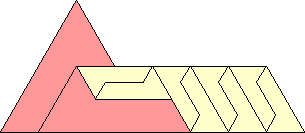
Isoperimetric polygons. Livio Zucca groups grid polygons by their perimeter instead of by their area. For small integer perimeter the results are just polyominos but after that it gets more complicated...
The isoperimetric problem for pinwheel tilings. In these aperiodic tilings (generated by a substitution system involving similar triangles) vertices are connected by paths almost as good as the Euclidean straight-line distance.
Isosceles pairs. Stan Wagon asks which triangles can be dissected into two isosceles triangles.
Isotiles, workbook on the shapes that can be formed by combining isosceles triangles with side lengths in the golden ratio.
Jacqui's Polyomino Workshop. Activities associated with polyominoes, aimed at the level of primary (or elementary) school mathematics.
Japanese Temple Geometry, Gordon Coale. See also this clickable temple geometry tablet map. Unfortunately Scientific American seems to have taken down their (May 1998) article on the subject.
Japanese Triangulation Theorem. The sum of inradii in a triangulation of a cyclic polygon doesn't depend on which triangulation you choose! Conversely, any polygon for which this is true is cyclic.
Java applets on mathematics, Walter Fendt.
Java gallery of geometric algorithms, Z. Zhao, Ohio State U.
Java lamp, S. M. Christensen.
Java quadric surface raytracer, P. Flavin.
Java pentomino puzzle solver, D. Eck, Hobart and William Smith Colleges.
Iwan Jensen counts polyominos (aka lattice animals), paths, and various related quantities.
Jenn open-source software for visualizing Cayley graphs of Coxeter groups as symmetric 4-dimensional polytopes.
Jiang Zhe-Ming's geometry challenge. A pretty problem involving cocircularity of five points defined by circles around a pentagram.
Jim ex machina. Escher-like tessellations by Jim McNeill.
Joe's Cafe. Java applets for creating images of iteration systems a la Field and Golubitsky's "Symmetry in Chaos".
Johnson Solids, convex polyhedra with regular faces. From Eric Weisstein's treasure trove of mathematics.
Jordan sorting. This is the problem of sorting (by x-coordinate) the intersections of a line with a simple polygon. Complicated linear time algorithms for this are known (for instance one can triangulate the polygon then walk from triangle to triangle); Paul Callahan discusses an alternate algorithm based on the dynamic optimality conjecture for splay trees.
Jovo Click 'n Construct. Plastic click-together triangular, square, and pentagonal tiles for building models of polyhedra and polygonal tilings. Includes a mathematical model gallery showing examples of shapes constructable from Jovo.
K12 on G6. Carlo Séquin investigates how to draw a 12-vertex complete graph as symmetrically as possible on a six-handle surface (the minimum genus surface on which it can be drawn without crossings).
Sándor Kabai's mathematical graphics, primarily polyhedra and 3d fractals.
Kabon Triangles. How many disjoint triangles can you make out of n line segments? From Eric Weisstein's treasure trove of mathematics. According to Toshi Kato, these should actually be called Kobon triangles, after Kobon Fujimura in Japan; Kato also tells me that Mr. Saburo Tamura proved a bound of F(n) <n(n-2)/3.
Kadon Enterprises, makers of games and puzzles including polyominoes and Penrose tiles.
The Kakeya-Besicovitch problem. Paul Wellin describes this famous problem of rotating a needle in a planar set of minimal area. As it turns out the area can be made arbitrarily close to zero. See also Steven Finch's page on Kakeya-Besicovitch constants, and Eric Weisstein's page on the Kakeya Needle Problem.
Kaleidoscope geometry, Ephraim Fithian.
Kaleidotile software for visualizing tilings of the sphere, Euclidean plane, and hyperbolic plane.
Kali, software for making symmetrical drawings based on any of the 17 plane tiling groups.
Robert F. Kauffman's fractal and Escherian art, with Escher-like animated animal-form tilings.
kD-tree demo. Java applet by Jacob Marner.
Keller's cube-tiling conjecture is false in high dimensions, J. Lagarias and P. Shor, Bull. AMS 27 (1992). Constructs a tiling of ten-dimensional space by unit hypercubes no two of which meet face-to-face, contradicting a conjecture of Keller that any tiling included two face-to-face cubes.
Aaron Kellner Linear Sculpture. Art in the form of geometric tangles of metal and wood rods.
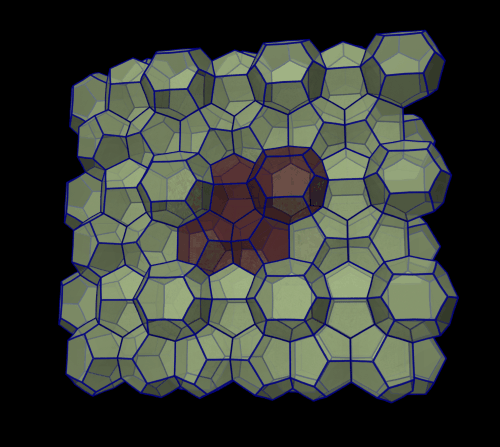
Kelvin conjecture counterexample. Evelyn Sander forwards news about the discovery by Phelan and Weaire of a better way to partition space into equal-volume low-surface-area cells. Kelvin had conjectured that the truncated octahedron provided the optimal solution, but this turned out not to be true. See also Ruggero Gabbrielli's comparison of equal-volume partitions and JavaView foam models.
Richard Kenyon's Gallery of tilings by squares and equilateral triangles of varying sizes.
The Kepler Conjecture on dense packing of spheres.
Kepler-Poinsot Solids, concave polyhedra with star-shaped faces. From Eric Weisstein's treasure trove of mathematics. See also H. Serras' page on Kepler-Poinsot solids.
King of Infinite Space. A new biography of H. S. M. Coxeter by Siobhan Roberts.
Kissing numbers. Eric Weisstein lists known bounds on the kissing numbers of spheres in dimensions up to 24.
Kleinian Groups. Rather incomprehensible exposition of hyperbolic symmetry, but plenty of pretty pictures.
The Kneser-Poulsen Conjecture. Bezdek and Connelly solve an old problem about pushing disks together.
Knight's Move Tessellations. Dan Thomasson looks at tilings with polygons that can be traced out by knight moves on a chessboard.
Knight's tour art, Dan Thomasson.
Knot art. Keith and Fran Griffin.
Knot pictures. Energy-minimized smooth and polygonal knots, from the ming knot evolver, Y. Wu, U. Iowa.
Knotology. How to form regular polyhedra from folded strips of paper?
KnotPlot. Pictures of knots and links, from Robert Scharein at UBC.
Knots on the Web, P. Suber. Includes sections on knot tying and knot art as well as knot theory.
Mike Kolountzakis' publications include several recent papers on lattice tiling.
Kummer's surface. Nice ray-traced pictures of a quartic surface with lots of symmetries.
Kurschak's tile and Kurschak's theorem about the area of a circle-inscribed dodecagon.
Labyrinth tiling. This aperiodic substitution tiling by equilateral and isosceles triangles forms fractal space-filling labyrinths.
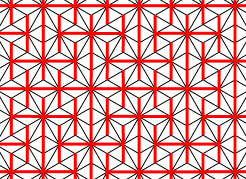
Landry Art, Escheresque tessellations, and balsa and paper polyhedra, including some prints, t-shirts, and models available for purchase.
The Landscape of Geometry Terms. Musical and typographic presentation of geometric nomenclature.
Language Generator Tool and Die Lab. Tennis ball theorems, hourglass theorems, and cellular hierarchies. From a truly self-programmed individual.
Largest 5-gon in a square, or more interestingly smallest equilateral pentagon inscribed in a square. Posting to sci.math by Rainer Rosenthal.
Lattice animal constant. What is the asymptotic behavior of the number of n-square polyominos, as a function of n? From MathSoft's favorite constants pages.
Lattice pentagons. The vertices of a regular pentagon are not the subset of any lattice.
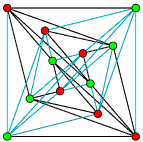
Laying Track. The combinatorics and topology of Brio train layouts. From Ivars Peterson's MathTrek.
Leaper tours. Can generalized knights jump around generalized chessboards visiting each square once? By Ed Pegg Jr.
Tom Lechner's Sculptures. Lechner makes geometric models from wood, water, plexiglass, and steel.
Lego Pentominos, Eric Harshbarger. He writes that the hard part was finding legos in enough different colors. See also his Lego math puzzles and pentominoes pages.
Lego sextic. Clive Tooth draws infinity symbols using lego linkages, and analyzes the resulting algebraic variety.
Lenses, rational-angled equilateral hexagons can tile the plane in various interesting patterns. See also Jorge Mireles' nice lens puzzle applet: rotate decagons and stars to get the pieces into the right places.
Mathematical imagery by Jos Leys. Knots, Escher tilings, spirals, fractals, circle inversions, hyperbolic tilings, Penrose tilings, and more.
LightSource sacred geometry software.
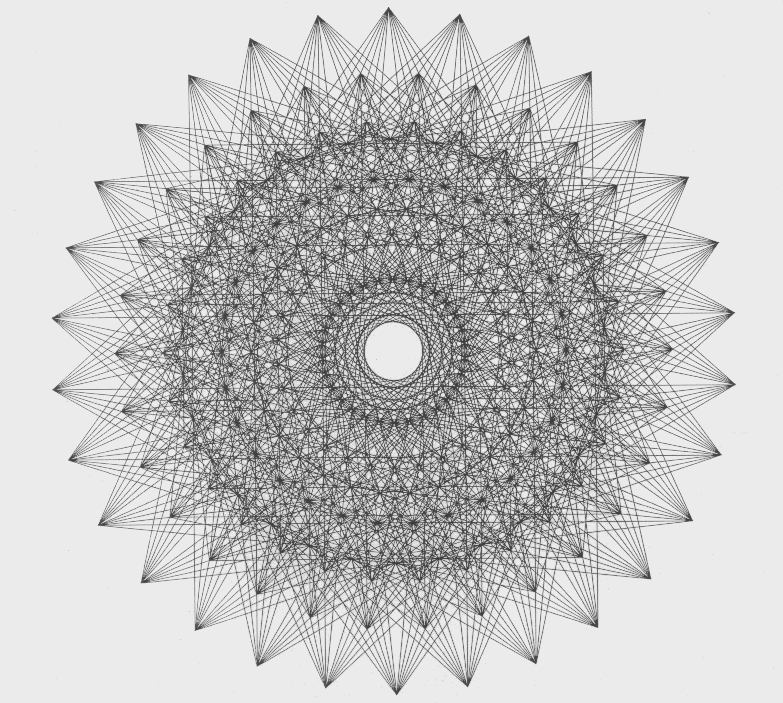
Line designs for the computer. Jill Britton brings to the web material from John Millington's 1989 book on geometric patterns formed by stitching yarn through cardboard. The Java simulation of a Spectrum computer running Basic programs is a little (ok a lot) clunky, and froze Mozilla when I tried it, but there's also plenty of interesting static content.
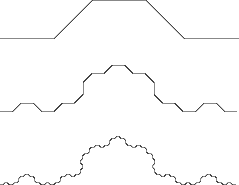
Line fractal. Java animation allows user control of a fractal formed by repeated replacement of line segments by similar polygonal chains.
-

LiveCube polycube puzzle building toy.
Logical art and the art of logic, pentomino art, philosophy, and DOS software, G. Albrecht-Buehler.
Log-spiral tiling, and other radial and spiral tilings, S. Dutch.
Looking at sunflowers. In this abstract of an undergraduate research paper, Surat Intasang investigates the spiral patterns formed by sunflower seeds, and discovers that often four sets of spirals can be discerned, rather than the two sets one normally notices.
Louis Bel's povray galleries: les polyhèdres réguliers, knots, and more knots.
Jim Loy's geometry pages. With special emphases on geometric constructions (and non-constructions such as trisection of an angle) as well as many nice Cinderella animations.
M203 Cabri Page. Wilson Stothers explains the geometry of conic sections using the Cabri-géomètre dynamic geometry software system.
Magazine Puzzle Fun. Fifteen years of back issues of an Argentine magazine about pentominoes (in English).
A magic geometric constant optimized by the Reuleaux triangle.
Magical transformations. Wil Laan animates several dissections and almost-dissections.
MagicTile. Klein's quartic meets the Rubik's cube, by Roice Nelson.
Maille Weaves. Different repetitive patterns formed by linked circles along a plane in space, as used for making chain mail. Along with some linear patterns for jewelry chains.
Making a Sierpinski pyramid with Maple, S. Sutherland, Stony Brook.
3-Manifolds from regular solids. Brent Everitt lists the finite volume orientable hyperbolic and spherical 3-manifolds obtained by identifying the faces of regular solids.
Manipula Math with Java. Interactive applets to help students grasp the meaning of mathematical ideas.
A map of all triangles and the search for the ideal acute scalene triangle, Robert Simms.
The Margulis Napkin Problem. Jim Propp asked for a proof that the perimeter of a flat origami figure must be at most that of the original starting square. Gregory Sorkin provides a simple example showing that on the contrary, the perimeter can be arbitrarily large.
Marius Fine Art Studio Sacred Geometry Art. Prints and paintings for sale of various geometric designs.
Martin's pretty polyhedra. Simulation of particles repelling each other on the sphere produces nice triangulations of its surface.
Materialized Mathematical Models. Jan de Koning exercises his furniture-making skills by making wood, plastic, stone and steel polyhedra.
Match sticks in the summer. Ivars Peterson discusses the graphs that can be formed by connecting vertices by non-crossing equal-length line segments.
Math Made Easy: Geometry interactive video supplemental learning materials.
Mathematica Menger Sponge, Robert M. Dickau.
Mathematical balloon twisting. Vi Hart makes polyhedra and polyhedral tangles from balloons.
Mathematical lego sculptures and Escher Lego, Andrew Lipson.
Mathematical origami, Helena Verrill. Includes constructions of a shape with greater perimeter than the original square, tessellations, hyperbolic paraboloids, and more.
A mathematical theory of origami. R. Alperin defines fields of numbers constructible by origami folds.
Mathematically correct breakfast. George Hart describes how to cut a single bagel into two linked Möbius strips. As a bonus, you get more surface area for your cream cheese than a standard sliced bagel.
The mathematics of polyominoes, K. Gong. Counts of k-ominoes, Macintosh polyomino software, and more links.
Mathematics in John Robinson's symbolic sculptures. Borromean rings, torus knots, fiber bundles, and unorientable geometries.
Mathenautics. Visualization of 3-manifold geometry at the Univ. of Illinois.
MatHSoliD Java animation of planar unfoldings of the Platonic and Archimedean polyhedra.
Max. non-adjacent vertices on 120-cell. Sci.math discussion on the size of the maximum independent set on this regular 4-polytope. Apparently it is known to be between 220 and 224 inclusive.
Maximizing the minimum distance of N points on a sphere, ray-traced by Hugo Pfoertner.
Maximum convex hulls of connected systems of segments and of polyominoes. Bezdek, Brass, and Harborth place bounds on the convex area needed to contain a polyomino.
Measurement sample. Ed Dickey advocates teaching about sphere packings and kissing numbers to high school students as part of a teaching strategy involving manipulative devices.
Menger Cubes, Peter C. Miller. Including some animated ray traces and a discussion of eliminating irrelevant internal surfaces prior to rendering.
Menger sponge floating in space. Everyone and his brother makes ray-traced fractals with unlikely backgrounds nowadays, but Cliff Pickover was there first.
Meru Foundation appears to be another sacred geometry site, with animated gifs of torus knots and other geometric visualizations and articles.
MicroGeometry volume and surface area calculator for the Palm.
Midpoint triangle porism. Two nested circles define a continuous family of triangles having endpoints on the outer circle and edge midpoints on the inner circle. A similar porism works for quadrilaterals and, seemingly, higher order polygons. Geometer's sketchpad animations by John Berglund.
Min-energy configurations of electrons on a sphere, K. S. Brown.
The MindBlock. Reassemble a chessboard cut into twelve interlocking polyominos.
Minesweeper on Archimedean polyhedra, Robert Webb.
A minimal domino tiling. How small a square board can one fill with dominos in a way that can't be separated into two smaller rectangles? From Stan Wagon's PotW archive.
A minimal winter's tale. Macalester College's snow sculpture of Enneper's surface wins second place at Breckenridge.
Minimax elastic bending energy of sphere eversions. Rob Kusner, U. Mass. Amherst.
Minimize the slopes. How few different slopes can be formed by the lines connecting 881 points? From Stan Wagon's PotW archive.
Maximum volume arrangements of points on a sphere, Hugo Pfoertner.
Miquel's pentagram theorem on circles associated with a pentagon. With annoying music.
Miquel's six circles in 3d. Reinterpreting a statement about intersecting circles to be about inscribed cuboids.

Mirror Curves. Slavik Jablan investigates patterns formed by crisscrossing a curve around points in a regular grid, and finds examples of these patterns in art from various cultures.
Mirrored room illumination. A summary by Christine Piatko of the old open problem of, given a polygon in which all sides are perfect mirrors, and a point source of light, whether the entire polygon will be lit up. The answer is no if smooth curves are allowed. See also Eric Weisstein's page on the Illumination Problem.
Miscellaneous polyomino explorations. Alexandre Owen Muniz looks at double polyomino tilings that simultaneously cover all half-grid edges, magic polyominoes, and more.
Mitre Tiling. Ed Pegg describes the discovery of the versatile tiling system (with Adrian Fisher and Miroslav Vicher), also discussing many other interesting tilings including a tile that can fill the plane with either five-fold or six-fold symmetry.
Möbius at the Shopping Mall. Topological sculpture as public seating. From MathTrek.
Modeling mollusc shells with logarithmic spirals, O. Hammer, Norsk Net. Tech. Also includes a list of logarithmic spiral links.
Models of Mathematical Machines at the University Museum of Natural Science and Scientific Instruments of the University of Modena. Main exhibit is in Italian but there is an English preface and htm.
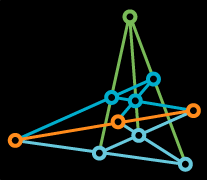
Models of Small Geometries. Burkard Polster draws diagrams of combinatorial configurations such as the Fano plane and Desargues' theorem (shown below) in an attempt to capture the mathematical beauty of these geometries.
Modular pie-cosahedron. Turkey Tek makes geometric models out of pecan pie.
Modularity in art. Slavik Jablan explores connections between art, tiling, knotwork, and other mathematical topics.
Moebius transformations revealed. Video by Douglas N. Arnold and Jonathan Rogness explaining 2d Moebius transformations in terms of the motions of a 3d sphere. See also MathTrek.
Monge's theorem and Desargues' theorem, identified. Thomas Banchoff relates these two results, on colinearity of intersections of external tangents to disjoint circles, and of intersections of sides of perspective triangles, respectively. He also describes generalizations to higher dimensional spheres.
More hyperbolic tilings and software for creating them, J. Mount.
Moser's Worm. What is the smallest area shape (in a given class of shapes) that can cover any unit-length path? Part of Mathsoft's collection of mathematical constants.
Mostly modular origami. Valerie Vann makes polyhedra out of folded paper.
Movies by Impulse. Computational geometry applied to the simulation of bowling allies and poolhalls.
Mutations and knots. Connections between knot theory and dissection of hyperbolic polyhedra.
N-dimensional cubes, J. Bowen, Oxford.
Natural neighbors. Dave Watson supplies instances where shapes from nature are (almost) Voronoi polygons. He also has a page of related references.
Mike Naylor's ASCII art. Platonic solids, knots, fractals, and more.
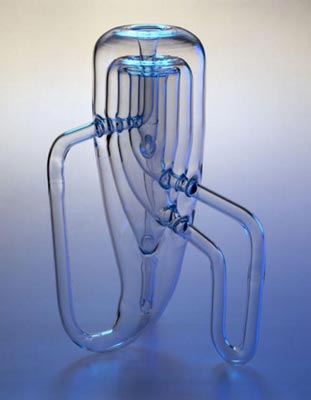
Nested Klein bottles. From the London Science Museum gallery, by way of Boing Boing. Topological glassware by Alan Bennett.
Netlib polyhedra. Coordinates for regular and Archimedean polyhedra, prisms, anti-prisms, and more.
New directions in aperiodic tilings, L. Danzer, Aperiodic '94.
A new Masonic interpretation of Euclid's 47th Problem. Confused about why those wacky Freemasons care so much about the Pythagorean Theorem, Bro. Jeff Peace proposes the existence of a different Euclid and a different 47th problem more related to theology than geometry.
New perspective systems, by Dick Termes, an artist who paints inside-out scenes on spheres which give the illusion of looking into separate small worlds. His site also includes an unfolded dodecahedron example you can print, cut, and fold yourself.
Mark Newbold's Rhombic Dodecahedron Page.
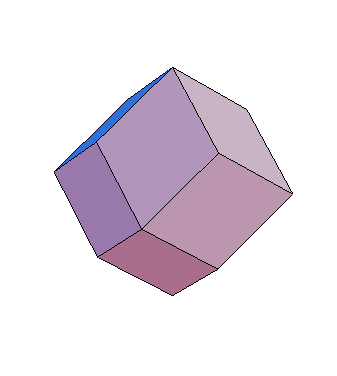
Nine. Drew Olbrich discovers the associahedron by evenly spacing nine points on a sphere and dualizing.
No cubed cube. David Moews offers a cute proof that no cube can be divided into smaller cubes, all different.
The no-three-in-line problem. How many points can be placed in an n*n grid with no three on a common line? The solution is known to be between 1.5n and 2n. Achim Flammenkamp discusses some new computational results including bounds on the number of symmetric solutions.
Non-Euclidean games implemented in Shockwave by students in an advanced high school geometry class: projective-plane asteroids, hyperbolic double-torus minesweeper, and cubical fruitarian snake.
Non-Euclidean geometry with LOGO. A project at Cardiff, Wales, for using the LOGO programming language to help mathematics students visualise non-Euclidean geometry.
Nonorthogonal polyhedra built from rectangles. Melody Donoso and Joe O'Rourke answer an open question of Biedl, Lubiw, and Sun.
Non periodic tiling of the plane. Including Penrose tiles, Pinhweel tiling, and more. Paul Bourke.
Nontrivial convexity. Ed Pegg asks about partitions of convex regions into equal tiles, other than the "trivial" ones in which some rotational or translational symmetry group relates all the tile positions to each other. See also Miroslav Vicher's page on nontrivial convexity.
Not. AMS Cover, Apr. 1995. This illustration for an article on geometric tomography depicts objects (a cuboctahedron and warped rhombic dodecahedron) that disguise themselves as regular tetrahedra by having the same width function or x-ray image.
Number patterns, curves, and topology, J. Britton. Includes sections on the golden ratio, conics, Moiré patterns, Reuleaux triangles, spirograph curves, fractals, and flexagons.
Objects that cannot be taken apart with two hands. J. Snoeyink, U. British Columbia.
Occult correspondences of the Platonic solids. Some random thoughts from Anders Sandberg.
Occurrence of the conics. Jill Britton explains how the different conic curves can all be formed by slicing the same cone at different angles, and finds many examples of them in technology and nature.
Octacube. Stainless steel 3d model of the 24-cell (one of the six regular polytopes in four dimensions), by Adrian Ocneanu, installed as a sculpture in the Penn State Math Department. Includes also a shockwave flythrough of the model.
Odd rectangles for L4n+2. Phillippe Rosselet shows that any L-shaped (4n+2)-omino can tile a rectangle with an odd side.
Odd squared distances. Warren Smith considers point sets for which the square of each interpoint distance is an odd integer. Clearly one can always do this with an appropriately scaled regular simplex; Warren shows that one can squeeze just one more point in, iff the dimension is 2 (mod 4). Moshe Rosenfeld has published a related paper in Geombinatorics (vol. 5, 1996, pp. 156-159).
Oops image warper, based on three simple geometric transformations.
Open problems:
Demaine - Mitchell - O'Rourke open problems project
From Jeff Erickson, Duke U.
From Jorge Urrutia, U. Ottawa.
From the 2nd MSI Worksh. on Computational Geometry. From SCG '98.Optimal illumination of a sphere. An interesting variation on the problem of equally spacing points, by Hugo Pfoertner.
The Optiverse. An amazing 6-minute video on how to turn spheres inside out.
Origami: a study in symmetry. M. Johnson and B. Beug, Capital H.S.
Origami & math, Eric Andersen.
Origami mathematics, Tom Hull, Merrimack.
Origami Menger Sponge built from Sonobe modules by K. & W. Burczyk.
Origami polyhedra. Jim Plank makes geometric constructions by folding paper squares.
Origami proof of the Pythagorean theorem, Vi Hart.
Origami Tesselations. Geometric paperfolding by Eric Gjerde.
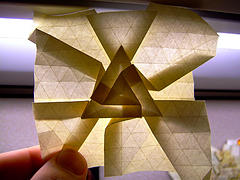
Origami tessellations and paper mosaics, Alex Bateman.
Origamic tetrahedron. The image below depicts a way of making five folds in a 2-3-4 triangle, so that it folds up into a tetrahedron. Toshi Kato asks if you can fold the triangle into a tetrahedron with only three folds. It turns out that there is a unique solution, although many tetrahedra can be formed with more folds.
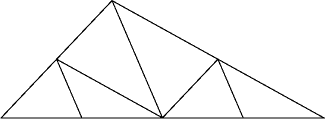
The Origami Lab. New Yorker article on Robert Lang's origami mathematics.
Orthogonal discrete knots. Hew Wolff asks questions about the minimum total length, or the minimum volume of a rectangular box, needed to form different knots as three-dimensional polygons using only integer-length axis-parallel edges.
Ozbird Escher-like tessellations by John Osborn, including several based on Penrose tilings.
Ozzigami tessellations, papercraft, unfolded peel-n-stick glitter Platonic solids, and more.
Packing circles in circles and circles on a sphere, Jim Buddenhagen. Mostly about optimal packing but includes also some nonoptimal spiral and pinwheel packings.
Packing circles in the hyperbolic plane, Java animation by Kevin Pilgrim illustrating the effects of changing radii in the hyperbolic plane.
Packing Ferrers Shapes. Alon, Bóna, and Spencer show that one can't cover very much of an n by p(n) rectangle with staircase polyominoes (where p(n) is the number of these shapes).
Packing polyominoes. Mark Michell investigates the problem of arranging pentominoes into rectangles of various (non-integer) aspect ratios, in order to saw the largest possible pieces from a given size piece of wood.
Packing pennies in the plane, an illustrated proof of Kepler's conjecture in 2D by Bill Casselman.
Packing rectangles into similar rectangles. A problem of the month from Erich Friedman's Math Magic site: how small an aspect-ratio-r rectangle can contain n unit-area aspect-ratio-r rectangles? As you might hope for in a problem dealing with aspect ratios of rectangles, the golden rectangle does show up, as one of the breakpoints in the size function for packing five smaller rectangles.
Packing Tetrahedrons, and Closing in on a Perfect Fit. Elizabeth Chen and others use experiments on hundreds of D&D dice to smash previous records for packing density.
Packings in Grassmannian spaces, N. Sloane, AT&T. How to arrange lines, planes, and other low-dimensional spaces into higher-dimensional spaces.
A pair of triangle centers, Vincent Goffin. Do these really count as centers? They are invariant under translation and rotation but switch places under reflection.
Pairwise touching hypercubes. Erich Friedman asks how to partition the unit cubes of an a*b*c-unit rectangular box into as many connected polycubes as possible with a shared face between every pair of polycubes. He lists both general upper and lower bounds as functions of a, b, and c, and specific constructions for specific sizes of box. I've seen the same question asked for d-dimensional hypercubes formed out of 2^d unit hypercubes; there is a lower bound of roughly 2d/2 (from embedding a 2*2d/2*2d/2 box into the hypercube) and an upper bound of O(2d/2 sqrt d) (from computing how many cubes must be in a polycube to give it enough faces to touch all the others).
Paper folding a 30-60-90 triangle. From the geometry.puzzles archives.
Paperfolding and the dragon curve. David Wright discusses the connections between the dragon fractal, symbolic dynamics, folded pieces of paper, and trigonometric sums.
Paperforms. John Vonachen uses laser cutters and spray paint to make and sell paper models of polyhedra, stellated polyhedra, polyhedral complexes, Sierpinski tetrahedra, etc.
Pappus on the Archimedean solids. Translation of an excerpt of a fourth century geometry text.
Paraboloid. Ray-traced image created to illustrate the lifting transformation used to relate Delaunay triangulation with convex hulls in one higher dimension.
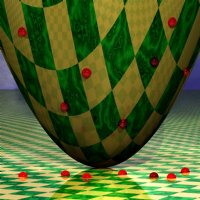
Parallel pentagons. Thomas Feng defines these as pentagons in which each diagonal is parallel to its opposite side, and asks for a clean construction of a parallel pentagon through three given points. (He is aware of the obvious reduction via affine transformation to the construction of regular pentagons, but finds that non-elegant.)
Parquet deformations. Craig Kaplan involves continuous spatial transformations of one tiling to another.
The Partridge Puzzle. Dissect an (n choose 2)x(n choose 2) square into 1 1x1 square, 2 2x2 squares, etc. The 30-60-90 triangle version of the puzzle is also interesting
Patterns within rhombic Penrose tilings. Stephen Collins' program "Bob" generates these tilings and explores the patterns formed by geodesic walks in them.
Pavages hyperboliques dans le modèle de Poincaré. Animated with CabriJava. Includes separate pages on hyperbolic tilings with regular polygons including squares, pentagons, and hexagons.
The pavilion of polyhedreality. George Hart makes geometric constructions from coffee stirrers and dacron thread. Includes many pointers to related web pages.
Peek, software for visualizing high-dimensional polytopes.
Penguins on the hyperbolic plane, Misha Kapovich. See also his Escher-like Crocodiles on the Euclidean plane.
Pennies in a tray, Ivars Peterson.
Penrose mandala and five-way Borromean rings.
Penrose quilt on a snow bank, M.&S. Newbold. See also Lisbeth Clemens' Penrose quilt.
The penrose tile and the golden mean: towards hyperdimensional intergeometry.
Penrose tiles and how their visualization leads to strange looks from priests and small children. Drew Olbrich.
Penrose tiles and worse. This article from Dave Rusin's known math pages discusses the difficulty of correctly placing tiles in a Penrose tiling, as well as describing other tilings such as the pinwheel.
Penrose tilings. This five-fold-symmetric tiling by rhombs or kites and darts is probably the most well known aperiodic tiling.
Perplexing pentagons, Doris Schattschneider, from the Discovering Geometry Newsletter. A brief introduction to the problem of tiling the plane by pentagons.
Pentagon packing on a circle and on a sphere, T. Tamai.
Pentagonal coffee table with rhombic bronze casting related to the Penrose tiling, by Greg Frederickson.
Pentagonal Tessellations. John Savard experiments with substitution systems to produce tilings resembling Kepler's.
Pentagons that tile the plane, Bob Jenkins. See also Ed Pegg's page on pentagon tiles.
The pentagram and the golden ratio. Thomas Green, Contra Costa College.
Pentamini. Italian site on pentominoes, by L. Zucca.
Pentomino. Extensive website on polyomino problems, developed by secondary school students in Belgium. Includes regular prize contest problems involving maximizing the area enclosed by polyominos in various ways.
The Pentomino Dictionary and other oulipian exercises, G. Esposito-Farèse. The twelve pentominoes resemble letters; what words do they spell? Also includes sections on "perecquian" configurations and a pentomino jigsaw puzzle.
Pentomino dissection of a square annulus. From Scott Kim's Inversions Gallery.
Pentomino project-of-the-month from the Geometry Forum. List the pentominoes; fold them to form a cube; play a pentomino game. See also proteon's polyomino cube-unfoldings and Livio Zucca's polyomino-covered cube.
Pento - A Program to Solve the Pentominoes Problem. Sean Vyain.
Pento pentomino solving software from Amamas Software.
Pentomino HungarIQa. What happens to standard pentomino puzzles and games if you use poly-rhombs instead of poly-squares?
Pentomino relationships. A. Smith classifies pentomino packings according to their shared subpatterns.
Pentominoes - an introduction. From the Centre for Innovation in Mathematics Teaching.
Penumbral shadows of polygons form projections of four-dimensional polytopes. From the Graphics Center's graphics archives.
Perron Number Tiling Systems. Mathematica software for computing fractals that tile the plane from Perron numbers.
Person polygons. Marc van Kreveld defines this interesting and important class of simple polygons, and derives a linear time algorithm (with a rather large constant factor) for recognizing a special case in which there are many reflex vertices.
The Perspective Page. A short introduction to the geometry of perspective drawing.
Phaistos disk geometry. Claire Watson examines the patterns on a Mediterranean bronze-age artifact.
Lorente Philippe's pentomino homepage. In French.
Pi curve. Kevin Trinder squares the circle using its involute spiral. See also his quadrature based on the 3-4-5 triangle.
Pi squared by six rectangle dissected into unequal integer squares (or an approximation thereof) by Clive Tooth.
Pick's Theorem. Mark Dominus explains the formula for area of polygons with vertices in an integer grid.
Pictures of 3d and 4d regular solids, R. Koch, U. Oregon. Koch also provides some 4D regular solid visualization applets.
Pictures of various spirals, Eric Weeks.
Place kicking locus in rugby, Michael de Villiers. See also Villiers' other geometry papers.
Plan for pocket-machining Austria, M. Held, Salzburg.
Plane color. How big can the difference between the numbers of black and white regions in a two-colored line arrangement? From Stan Wagon's PotW archive.
Plates and crowns. Erich Friedman investigates the convex polygons that can be dissected into certain pentagons and heptagons having all angles right or 135 degrees.
Plato, Fuller, and the three little pigs. Paul Flavin makes tensegrity structures out of ball point pens and rubber bands.
The Platonic solids. With Java viewers for interactive manipulation. Peter Alfeld, Utah.
Platonic solids and Euler's formula. Vishal Lama shows how the formula can be used to show that the familiar five Platonic solids are the only ones possible.
Platonic solids and quaternion groups, J. Baez.
Platonic solids transformed by Michael Hansmeyer using subdivision-surface algorithms into shapes resembling radiolarans. See also Boing Boing discussion.
Platonic spheres. Java animation, with a discussion of platonic solid classification, Euler's formula, and sphere symmetries.
Platonic tesselations of Riemann surfaces, Gerard Westendorp.
Platonic Universe, Stephan Werbeck. What shapes can you form by gluing regular dodecahedra face-to-face?
Pleats, twists, and sliceforms. Some links to Richard Sweeney's fractal paperfolding art, via dataisnature.
Plexagons. Ron Evans proposes to use surfaces made out of pleated hexagons as modular construction units. Paul Bourke explains.
Plücker coordinates. A description by Bob Knighten of this useful and standard way of giving coordinates to lines, planes, and higher dimensional subspaces of projective space.
Points on a sphere. Paul Bourke describes a simple random-start hill-climbing heuristic for spreading points evenly on a sphere, with pretty pictures and C source.
Poly, Windows/Mac shareware for exploring various classes of polyhedra including Platonic solids, Archimedean solids, Johnson solids, etc. Includes perspective views, Shlegel diagrams, and unfolded nets.
The Poly Pages. Andrew L. Clarke provides information and links on the various polyforms.
PolyB Unix software for enumerating lattice animals, Paul Janssens.
Polycell. George Olshevsky makes and sells polyhedra from colored cardstock.
Polydron patented polychromatic plastic polygons.
Polyedergarten. Ulrich Mikloweit makes polyhedral models out of colored typewriter paper, cut into lace so you can see the internal structure.
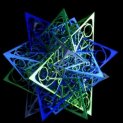
PolygonPat Australian school program involving coloring in geometric patterns in glazed terracotta.
Polygon power. How can one arrange six points to maximize the number of simple polygons having all six points as vertices? From Stan Wagon's PotW archive. See also Heidi Burgiel's simple n-gon counter.
Polygon Puzzle open source polyomino and polyform placement solitaire game.
Polygonal and polyhedral geometry. Dave Rusin, Northern Illinois U.
Polygons as projections of polytopes. Andrew Kepert answers a question of George Baloglou on whether every planar figure formed by a convex polygon and all its diagonals can be formed by projecting a three-dimensional convex polyhedron.
Polygons, polyhedra, polytopes, R. Towle.
Polygons with angles of different k-gons. Leroy Quet asks whether polygons formed by combining the angles of different regular polygons can tile the plane. The answer turns out to be related to Egyptian fraction decompositions of 1 and 1/2.
Polyhedra. Bruce Fast is building a library of images of polyhedra. He describes some of the regular and semi-regular polyhedra, and lists names of many more including the Johnson solids (all convex polyhedra with regular faces).
Polyhedra Blender. Mathematica software and Java-based interactive web gallery for what look like Minkowski sums of polyhedra. If the inputs to the Minkowski sums were line segments, cubes, or zonohedra, the results would be again zonohedra, but the ability to supply other inputs allows more general polyhedra to be formed.
Polyhedra collection, V. Bulatov.
Polyhedra exhibition. Many regular-polyhedron compounds, rendered in povray by Alexandre Buchmann.
Polyhedra pastimes, links to teaching activities collected by J. Britton.
Polyhedra plaited with paper strips, H. B. Meyer. See also Jim Blowers' collection of plaited polyhedra.
A polyhedral analysis. Ken Gourlay looks at the Platonic solids and their stellations.
Polyhedral nets and dissection. David Paterson outlines an algorithm to search for minimal dissections.
Polyhedral solids. Ray-traced images by Tom Gettys, and a primer on constructing paper models.
Polyhedron man. Nice article from Ivars Peterson's Mathland about George Hart and his polyhedral art.
Polyforms. Ed Pegg Jr.'s site has many pages on tiling, packing, and related problems involving polyominos, polyiamonds, polyspheres, and related shapes.
PolyGloss. Wendy Krieger is unsatisfied with terminology for higher dimensional geometry and attempts a better replacement. Her geometry works include some other material on higher dimensional polytopes.
Polyiamond exclusion. Colonel Sicherman asks what fraction of the triangles need to be removed from a regular triangular tiling of the plane, in order to make sure that the remaining triangles contain no copy of a given polyiamond.
Polyiamonds. This Geometry Forum problem of the week asks whether a six-point star can be dissected to form eight distinct hexiamonds.
Polymorf geometric construction set system created by Rick Engel.
PolyMultiForms. L. Zucca uses pinwheel tilers to dissect an illustration of the Pythagorean theorem into few congruent triangles.
Polyomino applet, Wil Laan.
Polyomino covers. Alexandre Owen Muniz investigates the minimum size of a polygon that can contain each of the n-ominoes.
Polyomino enumeration, K. S. Brown.
Polyomino inclusion problem. Yann David wants to know how to test whether all sufficiently large polyominoes contain at least one member of a given set.
Polyomino problems and variations of a theme. Information about filling rectangles, other polygons, boxes, etc., with dominoes, trominoes, tetrominoes, pentominoes, solid pentominoes, hexiamonds, and whatever else people have invented as variations of a theme.
Polyomino tiling. Joseph Myers classifies the n-ominoes up to n=15 according to how symmetrically they can tile the plane.
Polyominoes, figures formed from subsets of the square lattice tiling of the plane. Interesting problems associated with these shapes include finding all of them, determining which ones tile the plane, and dissecting rectangles or other shapes into sets of them. Also includes related material on polyiamonds, polyhexes, and animals.
Polyominoes 7.0 Macintosh shareware.
Polyominoids, connected sets of squares in a 3d cubical lattice. Includes a Java applet as well as non-animated description. By Jorge L. Mireles Jasso.
Polypolygon tilings, S. Dutch.
Polytopia CD-ROMs on tessellations, polyhedra, honycombs, and polytopes.
Polytope movie page. GIF animations by Komei Fukuda.
Poncelet's porism, the theorem that if a polygon is simultaneously inscribed in one circle and circumscribed in another, then there exists an infinite family of such polygons, one touching each point of each circle. From the secret blogging seminar.
Popsicle stick bombs, lashings and weavings in the plane, F. Saliola.
Postscript geometry. Bill Casselman uses postscript to motivate a course in Euclidean geometry. See also his Coxeter group graph paper, and Ed Rosten's postscript doodles. Beware, however, that postscript can not really represent such basic geometric primitives as circles, instead approximating them by splines.
A pre-sliced triangle. Given a triangle with three lines drawn across it, how to draw more lines to make it into a triangulation? From Stan Wagon's PotW archive.
The Pretzel Page. Eric Sedgwick uses animated movies of twisting pretzel knots to visualize a theorem about Heegard splittings (ways of dividing a complex topological space into two simple pieces).
Primes of a 14-omino. Michael Reid shows that a 3x6 rectangle with a 2x2 bite removed can tile a (much larger) rectangle. It is open whether it can do this using an odd number of copies.
Prince Rupert's Cube. It's possible to push a larger cube through a hole drilled into a smaller cube. How much larger? 1.06065... From Eric Weisstein's treasure trove of mathematics.
Prince Rupert's tetrahedra? One tetrahedron can be entirely contained in another, and yet have a larger sum of edge lengths. But how much larger? From Stan Wagon's PotW archive.
Prints by Robert Fathauer. Escher-like interlocking animals form spiral tilings and fractals.
Programming for 3d modeling, T. Longtin. Tensegrity structures, twisted torus space frames, Moebius band gear assemblies, jigsaw puzzle polyhedra, Hilbert fractal helices, herds of turtles, and more.
Projective Duality. This Java applet by F. Henle of Dartmouth demonstrates three different incidence-preserving translations from points to lines and vice versa in the projective plane.
Project X. "a shape that is homogenized, saturated with equalities, inanely geometric, yet also irresolvable, paradoxical, UNHEALTHY"
Proofs of Euler's Formula. V-E+F=2, where V, E, and F are respectively the numbers of vertices, edges, and faces of a convex polyhedron.
Proteon's Puzzle Notes Wen-Shan Kao covers cubes with polyominos and polysticks, packs worms into boxes, and studies giant tangram like puzzles.
ProtoZone interactive shockwave museum exhibits for exploring geometric concepts such as symmetry, tiling, and wallpaper groups.
Pseudospherical surfaces. These surfaces are equally "saddle-shaped" at each point.
Publications on quasicrystals and aperiodic tilings, F. Gähler.
Pushing disks together. If unit disks move so their pairwise distances all decrease, does the area of their union also decrease?
Puzzle Fun, a quarterly bulletin edited by R. Kurchan about polyominoes and other puzzles.
Puzzle World gallery of hand-crafted mechanical puzzles. Includes many geometric toys and puzzles.
Puzzles. Discussions on the geometry.puzzles list, collected by topic at the Swarthmore Geometry Forum.
Puzzles with polyhedra and numbers, J. Rezende. Some questions about labeling edges of platonic solids with numbers, and their connections with group theory.
A Puzzling Journey To The Reptiles And Related Animals, and New Mosaics. Books on tiling by Karl Scherer.
The Puzzling World of Polyhedral Dissections. Stewart T. Coffin's classic book on geometric puzzles, now available in full text on the internet!
Pythagoras' Haven. Java animation of Euclid's proof of the Pythagorean theorem.
Pythagorean theorem by dissection, Pythagorean dissection part II, and Pythagorean dissection part III, Java Applets by A. Bogomolny.
Pythagorean tilings. William Heierman asks about dissections of rectangles into dissimilar integer-sided right triangles.
Quadrature. Michael Rack finds what appears to be an accurate numerical approximation to pi using compass and straightedge.
Quadrorhomb rotary engine with chambers defined by the bars of a twelve-bar linkage rotating around two nonconcentric axes.
Quaquaversal Tilings and Rotations. John Conway and Charles Radin describe a three-dimensional generalization of the pinwheel tiling, the mathematics of which is messier due to the noncommutativity of three-dimensional rotations.
Quark constructions. The sun4v.qc Team investigates polyhedra that fit together to form a modular set of building blocks.
Quark Park. An ephemeral outdoor display of geometric art, in Princeton, New Jersey. From Ivars Peterson's MathTrek.
Quasicrystals and aperiodic tilings, A. Zerhusen, U. Kentucky. Includes a nice description of how to make 3d aperiodic tiles from zometool pieces.
A quasi-polynomial bound for the diameter of graphs of polyhedra, G. Kalai and D. Kleitman, Bull. AMS 26 (1992). A famous open conjecture in polyhedral combinatorics (with applications to e.g. the simplex method in linear programming) states that any two vertices of an n-face polytope are linked by a chain of O(n) edges. This paper gives the weaker bound O(nlog d).
Quasitiler image, E. Durand.
Qubits, modular geometric building blocks by architect Mark Burginger, inspired by Fuller's geodesic domes.
Rabbit style object on geometrical solid. Complete and detailed instructions for this origami construction, in 3 easy steps and one difficult step.
Rainbow Sierpinski tetrahedron by Aécio de Féo Flora Neto.
Ram's Horn cardboard model of an interesting 3d spiral shape bounded by a helicoid and two nested cones.
Random domino tiling of an Aztec diamond and other undergrad research on random tiling.
Random spherical arc crossings. Bill Taylor and Tal Kubo prove that if one takes two random geodesics on the sphere, the probability that they cross is 1/8. This seems closely related a famous problem on the probability of choosing a convex quadrilateral from a planar distribution. The minimum (over all possible distributions) of this probability also turns out to solve a seemingly unrelated combinatorial geometry problem, on the minimum number of crossings possible in a drawing of the complete graph with straight-line edges: see also "The rectilinear crossing number of a complete graph and Sylvester's four point problem of geometric probability", E. Scheinerman and H. Wilf, Amer. Math. Monthly 101 (1994) 939-943, rectilinear crossing constant, S. Finch, MathSoft, and Calluna's pit, Douglas Reay.
Random polygons. Tim Lambert summarizes responses to a request for a good random distribution on the n-vertex simple polygons.
Rational maps with symmetries. Buff and Henriksen investigate rational functions invariant under certain families of Möbius transformations, and use them to generate symmetric Julia sets.
Rational square. David Turner shows that a rectangle can only be dissected into finitely many squares if its sides are in a rational proportion.
Rational triangles. This well known problem asks whether there exists a triangle with the side lengths, medians, altitudes, and area all rational numbers. Randall Rathbun provides some "near misses" -- triangles in which most but not all of these quantities are irrational. See also Dan Asimov's question in geometry.puzzles about integer right-angled tetrahedra.
Ray-trace rendering. Richard M. Smith uses POVray to view complex geometric scenes.
Realization Spaces of 4-polytopes are Universal, G. Ziegler and J. Richter-Gebert, Bull. AMS 32 (1995).
Realizing a Delaunay triangulation. Many authors have written Java code for computing Delaunay triangulations of points. But Tim Lambert's applet does the reverse: give it a triangulation, and it finds points for which that triangulation is Delaunay.
Reconstruction of a closed curve from its elliptic Fourier descriptor. The ancient epicycle theory of planetary motion, animated in Java.
Rectangles divided into (mostly) unequal squares, R. W. Gosper.
Rectangular cartograms: the game. Change the shape of rectangles (without changing their area) and group them into larger rectangular and L-shaped units to fit them into a given frame. Bettina Speckmann, TUE. Requires a browser with support for Java SE 6.
The reflection of light rays in a cup of coffee or the curves obtained with b^n mod p, S. Plouffe, Simon Fraser U. (Warning: large animated gif. You may prefer the more wordy explanation at Plouffe's other page on the same subject.)
Regard mathématique sur Bruxelles. Student project to photograph city features of mathematical interest and model them in Cabri.
Regular 4d polytope foldouts. Java animations by Andrew Weimholt. Also includes some irregular polytops.
Regular polyhedra as intersecting cylinders. Jim Buddenhagen exhibits ray-traces of the shapes formed by extending half-infinite cylinders around rays from the center to each vertex of a regular polyhedron. The boundary faces of the resulting unions form combinatorially equivalent complexes to those of the dual polyhedra.
Regular polytopes in higher dimensions. Russell Towle uses Mathematica to slice and dice simplices, hypercubes, and the other high-dimensional regular polytopes. See also Russell's 4D star polytope quicktime animations.
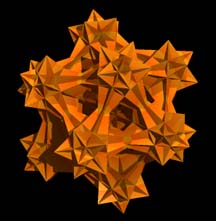
Regular polytopes in Hilbert space. Dan Asimov asks what the right definition of such a thing should be.
Regular solids. Information on Schlafli symbols, coordinates, and duals of the five Platonic solids. (This page's title says also Archimedean solids, but I don't see many of them here.)
Reproduction of sexehexes. Livio Zucca finds an interesting fractal polyhex based on a simple matching rule.
Reptile project-of-the-month from the Geometry Forum. Form tilings by dividing polygons into copies of themselves.
Research: spirals, Mícheál Mac an Airchinnigh. Presumably this connects to his thesis that "there is a geometry of curves which is computationally equivalent to a Turing Machine".
Resistance and conductance of polyhedra. Derek Locke computes formulae for networks of unit resistors in the patterns of the edges of the Platonic solids. See also the section on resistors in the rec.puzzles faq.
Reuleaux triangles. These curves of constant width, formed by combining three circular arcs into an equilateral triangle, can drill out (most of) a square hole.
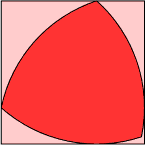
Reuleaux Wheel. From Mudd Math Fun Facts.
Vittoria Rezzonico's Java applets. Hypercube and polyhedron visualization, and circle inversion patterns. Requires both Java and JavaScript.
Rhombic spirallohedra, concave rhombus-faced polyhedra that tile space, R. Towle.
Rhombic tilings. Abstract of Serge Elnitsky's thesis, "Rhombic tilings of polygons and classes of reduced words in Coxeter groups". He also supplied the picture below of a rhombically tiled 48-gon, available with better color resolution from his website.
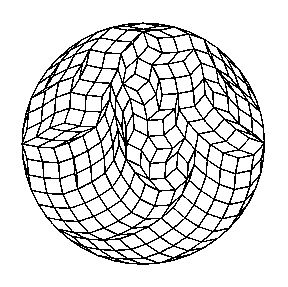
Rhombic triacosiohedron. Pretty model of a nonconvex genus-11 polyhedron with 300 congruent faces.
Riemann Surfaces and the Geometrization of 3-Manifolds, C. McMullen, Bull. AMS 27 (1992). This expository (but very technical) article outlines Thurston's technique for finding geometric structures in 3-dimensional topology.
Rigid regular r-gons. Erich Friedman asks how many unit-length bars are needed in a bar-and-joint linkage network to make a unit regular polygon rigid. What if the polygon can have non-unit-length edges?

Rob's polyhedron models, made with the help of his program Stella.
Robinson Friedenthal polyhedral explorations. Geometric sculpture.
Roger's Connection. Magnetic construction toy, scientific exploration tool, executive desk toy, magnet learning tool, architectural design tool, artistic sculpture system, manual dexterity training, and much more! (Make geometric shapes out of steel balls and magnet-tipped plastic tubes.) See also Simon Fraser's Roger's Connection gallery.
Rolling polyhedra. Dave Boll investigates Hamiltonian paths on (duals of) regular polyhedra.
Rolling with Reuleaux from Ivars Peterson's MathLand.
Romain triangle theorem. An analogue of the Pythagorean theorem for triangles in which one angle is twice another.
Rombix geometric puzzle based on dissections of regular polygons into joined pairs of rhombi.
The rotating caliper graph. A thrackle used in "Average Case Analysis of Dynamic Geometric Optimization" for maintaining the width and diameter of a point set.
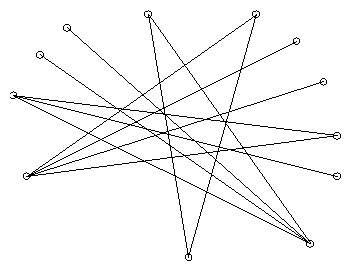
Rotating 4-cube applet, Bernd Grave Jakobi. For the German-challenged, Drehen starts the rotation and the other controls change the axis and speed of rotation.
Rotating zonohedron. This truncated rhombic dodecahedron forms the logo of the T. U. Berlin Algorithmic and Discrete Math. Group.
Rubik's Cube Menger Sponge, Hana Bizek.
Rubik's hypercube. 3x3x3x3 times as much puzzlement. Windows software from Melinda Green and Don Hatch, now also available as Linux executable and C++ source.
Rudin's example of an unshellable triangulation. In this subdivision of a big tetrahedron into small tetrahedra, every small tetrahedron has a vertex interior to a face of the big tetrahedron, so you can't remove any of them without forming a hole. Peter Alfeld, Utah.
The RUG FTP origami archive contains several papers on mathematical origami.
Ruler and Compass. Mathematical web site including special sections on the geometry of polyhedrons and geometry of polytopes.
Ruler and compass construction of the Fibonacci numbers and other integers, by David and Ken Sloan, Dan Litchfield and Dave Goldenheim, Domingo Gómez Morín, and an 1811 textbook.
Russian math olympiad problem on lattice points. Proof that, for any five lattice points in convex position, another lattice point is on or inside the inner pentagon of the five-point star they form.

Sacred Geometry. Mystic insights into the "principle of oneness underlying all geometry", mixed with occasional outright falsehoods such as the suggestion that dodecahedra and icosahedra arise in crystals. But the illustrative diagrams are ok, if you just ignore the words... For more mystic diagrams, see The Sacred Geometry Coloring Book.
Sacred geometry, new discoveries linking the great pyramid to the human form. Charles Henry finds faces in raytraces of reflecting spheres.
Sangaku problem. The incenters of four triangles in a cyclic quadrilateral form a rectangle. Animated in Shockwave by Antonio Gutierrez.
Santa Fe Ribbon, painting by Connie Simon featuring a rhombic Penrose tiling.
Santa Rosa Menger Cube made by Tom Falbo and helpers at Santa Rosa Junior College from 8000 1-inch-cubed oak blocks.
Satellite constellations. Sort of a dynamic version of a sphere packing problem: how to arrange a bunch of satellites so each point of the planet can always see one of them?
Sausage Conjecture. L. Fejes Tóth conjectured that, to minimize the volume of the convex hull of hyperspheres in five or more dimensions, one should line them up in a row. This has recently been solved for very high dimensions (d > 42) by Betke and Henk (see also Betke et al., J. Reine Angew. Math. 453 (1994) 165-191 and the MathWorld Sausage Conjecture Page).
The Schläfli Double Six. A lovely photo-essay of models of this configuration, in which twelve lines each meet five of thirty points. Unfortunately only the first page seems to be archived... (This site also referred to related configurations involving 27 lines meeting either 45 or 135 points, but didn't describe any mathematical details. For further descriptions of all of these, see Hilbert and Cohn-Vossen's "Geometry and the Imagination".)
Oded Schramm's mathematical picture gallery primarily concentrating in square tilings and circle packings, many forming fractal patterns.
In search of the ideal knot. Piotr Pieranski applies an iterative shrinking heuristic to find the minimum length unit-diameter rope that can be used to tie a given knot.
Seashell spirals. Xah Lee examines the shapes of various real seashells, and offers prize money for formulas duplicating them.
Secrets of Da Vinci's challenge. A discussion of the symbology and design of this interlocked-circle-pattern puzzle.
Sedona Sacred Geometry Conference, Feb. 2004.
Self-affine tiles, J. Lagarias and Y. Wang, DIMACS. Mathematics of a class of generalized reptiles.
Self-dual maps, Don McConnell.
Self-righting shapes. Figures with only one stable and one unstable equilibrium, when placed on a level surface. Surprisingly, they look much like certain kinds of turtles. Julie J. Rehmeyer in MathTrek.
Self-trapping random walks, Hugo Pfoertner.
Semi-regular tilings of the plane, K. Mitchell, Hobart and William Smith Colleges.
Sensitivity analysis for traveling salesmen, C. Jones, U. Washington. Still a good title, and now the geometry has been made more entertaining with Java and VRML.
Sets of points with many halving lines. Coordinates for arrangements of 14, 16, and 18 points for which many of the lines determined by two points split the remaining points exactly in half. From my 1992 tech. report.
Seven circle theorem, an applet illustrating the fact that if six circles are tangent to and completely surrounding a seventh circle, then connecting opposite points of tangency in pairs forms three lines that meet in a single point, by Michael Borcherds. see also Borcherds's include Poncelet's porism applet, a similar porism with an ellipse and a parabola and with two ellipses, and more generally with two conics of variable type.
75-75-30 triangle dissection. This isosceles triangle has the same area as a square with side length equal to half the triangle's long side. Ed Pegg asks for a nice dissection from one to the other.
Shape metrics. Larry Boxer and David Fry provide many bibliographic references on functions measuring how similar two geometric shapes are.
Sierpinski carpet on the sphere. From Curtis McMullen's math gallery.
Sierpinski cookies. Actually more like Menger cookies, but whatever.
Sierpinski gaskets and Menger sponges, Paul Bourke. Including stacks of coke cans, radio antennas, crumpled sponges, and more.
Sierpinski gaskets and variations rendered by D. H. Hepting.
Sierpinski pentatope video by Chris Edward Dupilka. A four-dimensional analogue of the Sierpinski triangle.
Sierpinski pyramid. C++ code for generating the Sierpinski tetrahedron.
The Sierpinski Tetrahedron, everyone's favorite three dimensional fractal. Or is it a fractal?
Sierpinski tetrahedron. Awful Mathematica code used by Robert Dickau to generate the following sequence of images.
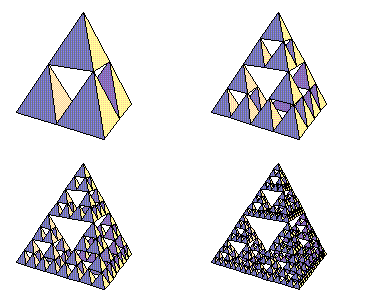
Sierpinski tetrahedron animation (MS-video format), Karl S. Frederickson.
Sierpinski triangle reptile based on a complex binary number system, R. W. Gosper.
Sierpinski valentine from XKCD.
Sighting point. John McKay asks, given a set of co-planar points, how to find a point to view them all from in a way that maximizes the minimum viewing angle between any two points. Somehow this is related to monodromy groups. I don't know whether he ever got a useful response. This is clearly polynomial time: the decision problem can be solved by finding the intersection of O(n2) shapes, each the union of two disks, so doing this naively and applying parametric search gives O(n4 polylog), but it might be interesting to push the time bound further. A closely related problem of smoothing a triangular mesh by moving points one at a time to optimize the angles of incident triangles can be solved in linear time by LP-type algorithms [Matousek, Sharir, and Welzl, SCG 1992; Amenta, Bern, and Eppstein, SODA 1997].
Similar division. Mineyuki Uyematsu, Michael Reid, and Ed Pegg ask for divisions of given shapes into pieces, where all pieces must be similar to each other.
A simple dodecahedron tiling puzzle. Cover the dodecahedron's faces with pentagonal tetrominos.
Simple polygonizations. Erik Demaine explores the question of how many different non-crossing traveling salesman tours an n-point set can have.
The Simplex: Minimal Higher Dimensional Structures. D. Anderson.
Simplex/hyperplane intersection. Doug Zare nicely summarizes the shapes that can arise on intersecting a simplex with a hyperplane: if there are p points on the hyperplane, m on one side, and n on the other side, the shape is (a projective transformation of) a p-iterated cone over the product of m-1 and n-1 dimensional simplices.
SingSurf software for calculating singular algebraic curves and surfaces, R. Morris.
Six-regular toroid. Mike Paterson asks whether it is possible to make a torus-shaped polyhedron in which exactly six equilateral triangles meet at each vertex.
Skewered lines. Jim Buddenhagen notes that four lines in general position in R3 have exactly two lines crossing them all, and asks how this generalizes to higher dimensions.
Sketchpad demo includes a Reuleaux triangle rolling between two parallel lines.
Sliced ball. Ray-traced image created to help describe recent algorithms for removing slivers from tetrahedral meshes.
Sliceforms, 3d models made by interleaving two directions of planar slices.
N. J. A. Sloane's netlib directory includes many references and programs for sphere packing and clustering in various models. See also his list of sphere-packing and lattice theory publications.
A small puzzle. Joe Fields asks whether a certain decomposition into L-shaped polyominoes provides a universal solution to dissections of pythagorean triples of squares.
SMAPO library of polytopes encoding the solutions to optimization problems such as the TSP.
Smarandache Manifolds online e-book by Howard Iseri. I'm not sure I see why this should be useful or interesting, but the idea seems to be to define geometry-like structures (having objects called points and lines that somehow resemble Euclidean points and lines) that are non-uniform in some strong sense: every Euclidean axiom (and why not, every Euclidean theorem?) should be true at some point of the geometry and false at some other point.
The smoothed octagon. A candidate for the symmetric convex shape that is least able to pack the plane densely.
Smoothly rolling polygonal wheels and their roads, H. Serras, Ghent.
Snakes. What is the longest path of unit-length line segments, connected end-to-end with angles that are multiples of some fixed d, and that can be covered by a square of given size?
SnapPea, powerful software for computing geometric properties of knot complements and other 3-manifolds.
sneJ made a Mandelbrot set with sheet plastic and a laser cutter.
Snowflake reptile hexagonal substitution tiling (sometimes known as the Gosper Island) rediscovered by NASA and conjectured to perform visual processing in the human brain.
Snub cube and dodecahedron. Rob Moeser makes geometric constructions by carving broccoli stalks.
Soap bubble 120-cell from the Geometry Center archives.
Soap films and grid walks, Ivar Peterson. A discussion of Steiner tree problems in rectilinear geometry.
Soap films on knots. Ken Brakke, Susquehanna.
Soccer ball pictures, spherical patterns generated by reflections that form rational angles to each other.
Soddy's Hexlet, six spheres in a ring tangent to three others, and Soddy's Bowl of Integers, a sphere packing combining infinitely many hexlets, from Mathworld.
Soddy Spiral. R. W. Gosper calculates the positions of a sequence of circles, each tangent to the three previous ones.
Sofa movers' problem. This well-known problem asks for the largest area of a two-dimensional region that can be moved through a hallway with a right-angled bend. Part of Mathsoft's collection of mathematical constants.
Solid object which generates an anomalous picture. Kokichi Sugihara makes models of Escher-like illusions from folded paper. He has plenty more where this one came from, but maybe the others aren't on the web.
Solution of Conway-Radin-Sadun problem. Dissections of combinations of regular dodecahedra, regular icosahedra, and related polyhedra into rhombs that tile space. By Dehn's solution to Hilbert's third problem this is impossible for individual dodecahedra and icosahedra, but Conway, Radin, and Sadun showed that certain combinations could work. Now Izidor Hafner shows how.
Solution to problem 10769. Apparently problems of coloring the points of a sphere so that orthogonal points have different colors (or so that each set of coordinate basis vectors has multiple colors) has some relevance to quantum mechanics; see also papers quant-ph/9905080 and quant-ph/9911040 (on coloring just the rational points on a sphere), as well as this four-dimensional construction of an odd number of basis sets in which each vector appears an even number of times, showing that one can't color the points on a four-sphere so that each basis set has exactly one black point.
Solution to the pentomino problem by pete@bignode.equinox.gen.nz, from the rec.puzzles archives.
Solving the Petersen Graph Zome Challenge. David MacMahon discovers that there is no way to make a non-self-intersecting peterson graph with Zome tool. Includes VRML illustrations.
The soma cube page and pentomino page, J. Jenicek.
Some generalizations of the pinwheel tiling, L. Sadun, U. Texas.
SpaceBric building blocks and Windows software based on a tiling of 3d space by congruent tetrahedra.
Space Cubes plastic geometric modeling puzzle based on a rectangular Borromean link.
Sphere distribution problems. Page of links to other pages, collected by Anton Sherwood.
Sphere packing and kissing numbers. How should one arrange circles or spheres so that they fill space as densely as possible? What is the maximum number of spheres that can simultanously touch another sphere?
Spheres and lattices. Razvan Surdulescu computes sphere volumes and describes some lattice packings of spheres.
Spheres with colorful chickenpox. Digana Swapar describes an algorithm for spreading points on a sphere to minimize the electrostatic potential, via a combination of simulated annealing and conjugate gradient optimization.
Spherical Julia set with dodecahedral symmetry discovered by McMullen and Doyle in their work on quintic equations and rendered by Don Mitchell. Update 12/14/00: I've lost the big version of this image and can't find DonM anywhere on the net -- can anyone help? In the meantime, here's a link to McMullen's rendering.

The sphericon, a convex shape with one curved face and two semicircular edges that can roll with a wobbling motion in a straight line. See also the national curve bank sphericon page, the MathWorld sphericon page, the Wikipedia sphericon page, The Differential Geometry of the Sphericon, and building a sphericon.
Spidron, a triangulated double spiral shape tiles the plane and various other surfaces. With photos of related paperfolding experiments.
Spira Mirabilis logarithmic spiral applet by A. Bogomily.
Spiral generator, web form for creating bitmap images of colored logarithmic spirals.
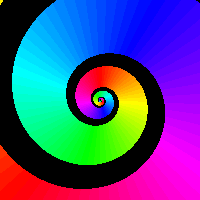
A spiral of squares with Fibonacci-number sizes, closely related to the golden spiral, Keith Burnett. See also his hand-painted Taramundi spiral.
Spiral tea cozy, Kathleen Sharp.
Spiral tilings. These similarity tilings are formed by applying the exponential function to a lattice in the complex number plane.
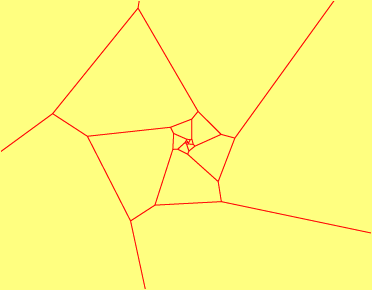
Spiral tower. Photo of a building in Iraq, part of a web essay on the geometry of cyberspace.
Spiral triangles, Eric Weeks.
Spiraling Sphere Models. Bo Atkinson studies the geometry of a solid of revolution of an Archimedean spiral.
Spirals, by Mike Callinan and Larry Shook.Using a spreadsheet to investigate the spirals formed by repeatedly nesting squares within larger squares.
Split square. How to subdivide a square into two rectangular pieces, one of which circumscribes the other?
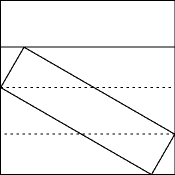
Spontaneous patterns in disk packings, Lubachevsky, Graham, and Stillinger, Visual Mathematics. A procedure for packing unit disks into square containers produces large grains of hexagonally packed disks with sporadic rattlers along the grain boundaries.
Spring into action. Dynamic origami. Ben Trumbore, based on a model by Jeff Beynon from Tomoko Fuse's book Spirals.
sqfig and sqtile, software by Eric Laroche for generating polyominoes and polyomino tilings.
Square Knots. This article by Brian Hayes for American Scientist examines how likely it is that a random lattice polygon is knotted.
Square wheels. Bill Beatty describes how to make cubical-looking shapes that are round enough to roll smoothly on an axle.
Squared squares and squared rectangles, thorough catalog by Stuart Anderson. Erich Friedman discusses several related problems on squared squares: if one divides a square into k smaller squares, how big can one make the smallest square? How small can one make the biggest square? How few copies of the same size square can one use? See also Robert Harley's four-colored squared square, Mathworld's perfect square dissection page, a Geometry Forum problem of the week on squared squares, Keith Burnett's perfect square dissection page, and Bob Newman's squared square drawing.
Squares are not diamonds. Izzycat gives a nice explanation of why these shapes should be thought of differently, even though they're congruent: they generalize to different things in higher dimensions.
Squares on a Jordan curve. Various people discuss the open problem of whether any Jordan curve in the plane contains four points forming the vertices of a square, and the related but not open problem of how to place a square table level on a hilltop. This is also in the geometry.puzzles archive.
Squaring the circle. BNTR finds a pretty geometric visualization of Gregory's Series for pi/4.
Speculations on the fourth dimension, Garrett Jones.
Splitting the hair. Matthew Merzbacher discusses how many times one can subdivide a line segment by following certain rules.
Stained glass icosidodecahedron and rhombicosidodecahedron, Helen & Liam Striker.
Star construction of shapes of constant width, animated in Java by A. Bogomolny.
Stardust Polyhedron Puzzles. This U.K. company sells unfolded polyhedral puzzles and space-packing shapes (including a nice model of the Weaire-Phelan space-filling foam) on card-stock, to cut out and build yourself.
Starpage. Art-deco paper models of stellated polyhedra, by merrill.
Stella and Stella4d, Windows software for visualizing regular and semi-regular polyhedra and their stellations in three and four dimensions, morphing them into each other, drawing unfolded nets for making paper models, and exporting polyhedra to various 3d design packages.
Stellations of the dodecahedron stereoscopically animated in Java by Mark Newbold.
Sterescopic polyhedra rendered with POVray by Mark Newbold.
Steve's sprinklers. An interesting 3d polygon made of copper pipe forms various symmetric 2d shapes when viewed from different directions.
Stomachion, a tangram-like shape-forming game based on a dissection of the square and studied by Archimedes.
The Story of the 120-cell, John Stillwell, Notices of the AMS. History, algebra, geometry, topology, and computer graphics of this regular 4-dimensional polytope.
Wilson Stothers' Cabri pages. Geometric animations teaching projective conics, hyperbolic geometry, and the Klein view of geometry as symmetry.
Straighten these curves. This problem from Stan Wagon's PotW archive asks for a dissection of a circle minus three lunes into a rectangle. The ancient Greeks performed similar constructions for certain lunules as part of an attempt to square the circle.
Strange unfoldings of convex polytopes, Komei Fukuda, ETH Zurich.
Structors. Panagiotis Karagiorgis thinks he can get people to pay large sums of money for exclusive rights to use four-dimensional regular polytopes as building floor plans. But he does have some pretty pictures...
Student of Hyperspace. Pictures of 6 regular polytopes, E. Swab.
Studio modular origami, geometric paper art.
Subdivision kaleidoscope. Strange diatom-like shapes formed by varying the parameters of a spline surface mesh refinement scheme outside their normal ranges.
Sums of square roots. A major bottleneck in proving NP-completeness for geometric problems is a mismatch between the real-number and Turing machine models of computation: one is good for geometric algorithms but bad for reductions, and the other vice versa. Specifically, it is not known on Turing machines how to quickly compare a sum of distances (square roots of integers) with an integer or other similar sums, so even (decision versions of) easy problems such as the minimum spanning tree are not known to be in NP. Joe O'Rourke discusses an approach to this problem based on bounding the smallest difference between two such sums, so that one could know how precise an approximation to compute.
Superliminal Geometry. Topics include deltahedra, infinite polyhedra, and flexible polyhedra.
Supershapes and 3d supershapes. Paul Bourke generates a wide variety of interesting shapes from a simple formula. See also John Whitfield's Nature article.
Sylvester's theorem. This states that any finite non-colinear point set has a line containing only two points (equivalently, every zonohedron has a quadrilateral face). Michael Larsen, Tim Chow, and Noam Elkies discuss two proofs and a complex-number generalization. (They omit the very simple generalization from Euler's formula: every convex polyhedron has a face of degree at most five.)
SymmeToy, windows shareware for creating paint patterns, symmetry roses, tessellated art and symmetrically decorated 3D polyhedron models.
Symmetry, tilings, and polyhedra, S. Dutch.
Symmetry and Tilings. Charles Radin, Not. AMS, Jan. 1995. See also his Symmetry of Tilings of the Plane, Bull. AMS 29 (1993), which proves that the pinwheel tiling is ergodic and can be generated by matching rules.
Symmetry web, an exploration of the symmetries of geometric figures.
Synergetic geometry, Richard Hawkins' digital archive. Animations and 3d models of polyhedra and tensegrity structures. Very bandwidth-intensive.
The Szilassi Polyhedron. This polyhedral torus, discovered by L. Szilassi, has seven hexagonal faces, all adjacent to each other. It has an axis of 180-degree symmetry; three pairs of faces are congruent leaving one unpaired hexagon that is itself symmetric. Tom Ace has more images as well as a downloadable unfolded pattern for making your own copy. See also Dave Rusin's page on polyhedral tori with few vertices and Ivars' Peterson's MathTrek article.
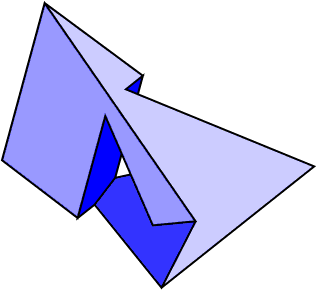
Tales of the dodecahedron, from Pythagoras to Plato to Poincaré. John Baez, Reese Prosser Memorial Lecture, Dartmouth, 2006.
Tangencies. Animated compass and straightedge constructions of various patterns of tangent circles.
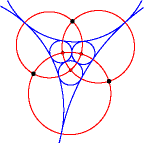
Tangencies of circles and spheres. E. F. Dearing provides formulae for the radii of Apollonian circles, and analogous three-dimensional problems.
Taprats Java software for generating symmetric Islamic-style star patterns.
The tea bag problem. How big a volume can you enclose by two square sheets of paper joined at the edges? See also the cubical teabag problem.
A teacher's guide to building the icosahedron as a class project.
Temari dodecahedrally decorated Japanese thread ball. See also Summer's temari gallery for many more.
Tensegrity zoology. A catalog of stable structures formed out of springs, somehow forming a quantum theory of what used to be described as time.
Tessellated polyhedra. Colored unfoldings of the Platonic solids, ready to be printed, cut out, and folded, by Jill Britton.
Tesselation world of Makoto Nakamura.
Tesselating locking polyominos, Bob Newman.
Tessellation links, S. Alejandre.
Tessellation resources. Compiled for the Geometry Center by D. Schattschneider.
Tessellations, a company which makes Puzzellations puzzles, posters, prints, and kaleidoscopes inspired in part by Escher, Penrose, and Mendelbrot.
Tessellations, Periodic Drawings, Computer Graphics, Latticework, ... William Chow likes Escher-like patterns of interlocking figure and really really long web page titles.
Tesseract and tesseract-embedded Möbius strip, A. Bogomolny.
Tetrahedra packing. Mathematica implementation of the Chen-Engel-Glotzer packing of space by regular tetrahedra, the densest known such packing to date.
Tetrahedral kite. A. Thyssen describes how to make Sierpinski tetrahedra out of soda straws, kite strings, and plastic shopping bags.
Tetrahedrons and spheres. Given an arbitrary tetrahedron, is there a sphere tangent to each of its edges? Jerzy Bednarczuk, Warsaw U.
Tetrahedra classified by their bad angles. From "Dihedral bounds for mesh generation in high dimensions".
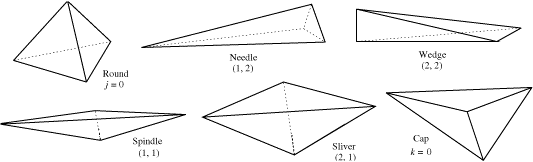
Tetrix. From Eric Weisstein's treasure trove.
These two pictures by Richard Phillips are from the now-defunct maths with photographs website. The chimney is (Phillips thinks) somewhere in North Nottinghamshire, England. A similar collection of Phillips' mathematical photos is now available on CD-ROM.
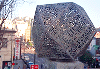
30 computers. Forrest McCluer makes polyhedral sculptures out of discarded electronics.
This is your brain on Tetris. Are pentominos really "an ancient Roman puzzle"?
Morwen Thistlethwait, sphere packing, computational topology, symmetric knots, and giant ray-traced floating letters.
Thoughts on the number six. John Baez contemplates the symmetries of the icosahedron.
Thrackles are graphs embedded as a set of curves in the plane that cross each other exactly once; Conway has conjectured that an n-vertex thrackle has at most n edges. Stephan Wehner describes what is known about thrackles.
Three classical geek problems solved! Hauke Reddmann, Hamburg.
Three-color the Penrose tiling? Mark Bickford asks if this tiling is always three-colorable. Ivars Peterson reports on a new proof by Tom Sibley and Stan Wagon that the rhomb version of the tiling is 3-colorable; A proof of 3-colorability for kites and darts was recently published by Robert Babilon [Discrete Mathematics 235(1-3):137-143, May 2001]. This is closely related to my page on line arrangement coloring, since every Penrose tiling is dual to a "multigrid", which is just an arrangement of lines in parallel families. But my page only deals with finite arrangements, while Penrose tilings are infinite.
Three cubes to one. Calydon asks whether nine pieces is optimal for this dissection problem.
3D-Geometrie. T. E. Dorozinski provides a gallery of images of 3d polyhedra, 2d and 3d tilings, and subdivisions of curved surfaces.
3d-XplorMath Macintosh software for visualizing curves, surfaces, polyhedra, conformal maps, and other planar and three-dimensional mathematical objects.
Three-dimensional models based on the works of M. C. Escher.
The three dimensional polyominoes of minimal area, L. Alonso and R. Cert, Elect. J. Combinatorics.
Three dimensional turtle talk description of a dodecahedron. The dodecahedron's description is "M40T72R5M40X63.435T288X296.565R5M40T72M40X63.435T288X296.565R4"; isn't that helpful?
3D strange attractors and similar objects, Tim Stilson, Stanford.
Three nice pentomino coloring problems, Owen Muniz.
Three spiral tattoos from the Discover Magazine Science Tattoo Emporium.
Three untetrahedralizable objects.
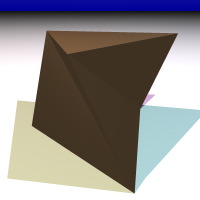
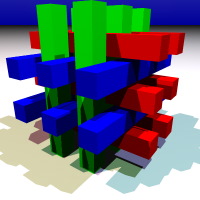
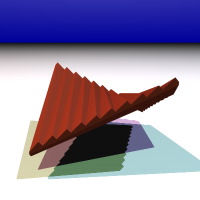
The Thurston Project: experimental differential geometry, uniformization and quantum field theory. Steve Braham hopes to prove Thurston's uniformization conjecture by computing flows that iron the wrinkles out of manifolds.
Tic tac toe theorem. Bill Taylor describes a construction of a warped tic tac toe board from a given convex quadrilateral, and asks for a proof that the middle quadrilateral has area 1/9 the original. Apparently this is not even worth a chocolate fish.
Tilable perspectives. Patrick Snels creates two-dimensional images which tile the plane to form 3d-looking views including some interesting Escher-like warped perspectives. See also his even more Escherian tesselations page.
TileDreams Windows software for creating symmetric patterns with rhombi.
A tiling from ell. Stan Wagon asks which rectangles can be tiled with an ell-tromino.
Tiling plane & fancy, Steven Edwards, SPSU.
Tiling the infinite grid with finite clusters. Mario Szegedy describes an algorithm for determining whether a (possibly disconnected) polyomino will tile the plane by translation, in the case where the number of squares in the polyomino is a prime or four.
Tiling the integers with one prototile. Talk abstract by Ethan Coven on a one-dimensional tiling problem on the boundary between geometry and number theory, with connections to factorization of finite cyclic groups. See also Coven's paper with Aaron Meyerowitz, Tiling the integers with translates of one finite set.
Tiling problems. Collected at a problem session at Smith College, 1993, by Marjorie Senechal.
The tiling puzzle games of OOG. Windows and Java software for tangrams, polyominoes, and polyhexes.
Tiling a rectangle with the fewest squares. R. Kenyon shows that any dissection of a p*q rectangle into squares (where p and q are integers in lowest terms) must use at least log p pieces.
Tiling rectangles and half strips with congruent polyominoes, and Tiling a square with eight congruent polyominoes, Michael Reid.
Tiling stuff. J. L. King examines problems of determining whether a given rectangular brick can be tiled by certain smaller bricks.
Tiling transformer. Java applet for subdividing tilings (starting from a square or hexagonal tiling) in various different ways.
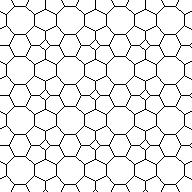
Tiling the unit square with rectangles. Erich Friedman shows that the 5/6 by 5/6 square can always be tiled with 1/(k+1) by 1/(k+1) squares. Will all the 1/k by 1/(k+1) rectangles, for k>0, fit together in a unit square? Note that the sum of the rectangle areas is 1. Marc Paulhus can fit them into a square of side 1.000000001: "An algorithm for packing squares", J. Comb. Th. A 82 (1998) 147-157, MR1620857.
Tiling with four cubes. Torsten Sillke summarizes results and conjectures on the problem of tiling 3-dimensional boxes with a tile formed by gluing three cubes onto three adjacent faces of a fourth cube.
Tiling with notched cubes. Robert Hochberg and Michael Reid exhibit an unboxable reptile: a polycube that can tile a larger copy of itself, but can't tile any rectangular block.
Tiling with polyominos. Michael Reid summarizes results on the ability to cover rectangles and other figures using polyominoes. See also Torsten Sillke's page of results on similar problems.
Tiling dynamical systems. Chris Hillman describes his research on topological spaces in which each point represents a tiling.
On a tiling scheme by M. C. Escher, D. Davis, Elect. J. Combinatorics.
Tilings. Lecture notes from the Clay Math Institute, by Richard Stanley and Federico Ardila, discussing polyomino tilings, coloring arguments for proving the nonexistence of tilings, counting how many tilings a region has, the arctic circle theorem for domino tilings of diamonds, tiling the unit square with unit-fraction rectangles, symmetry groups, penrose tilings, and more. In only 21 pages, including the annotated bibliography. A nice but necessarily concise introduction to the subject. (Via Andrei Lopatenko.)
Tilings and visual symmetry, Xah Lee.
Tobi Toys sell the Vector Flexor, a flexible cuboctahedron skeleton, and Fold-a-form, an origami business card that folds to form a tetrahedron that can be used as the building block for more complex polyhedra.
Toilet paper plagiarism. A big tissue company tries to rip off Sir Roger P.
Touch-3d, commercial software for unfolding 3d models into flat printouts, to be folded back up again for quick prototyping and mock-ups.
Toroidal tile for tessellating three-space, C. Séquin, UC Berkeley.
Totally Tessellated. Mosaics, tilings, Escher, and beyond.
A tour of Archimedes' stomachion. Fan Chung and Ron Graham investigate the number of different square solutions of this dissection puzzle.
The tractrix and the pseudosphere, hyperbolic surfaces modeled in Cabri.
Transformational geometry. Leslie Howe illustrates various plane symmetry types with Cabri animations.
Traveling salesman problem and Delaunay graphs. Mike Dillencourt and Dan Hoey revisit and simplify some older work showing that the traveling salesman tour of a point set need not follow Delaunay edges.
Trefoil knot stairs. Java animation of an Escher-like infinite stair construction, intended as a Montreal metro station sculpture, by Guillaume LaBelle.
Triangle geometry and the triangle book. Steve Sigur's web site describing many important triangle centers and loci. According to the site, he also has a book with John Conway on the subject, coming soon.
Triangle table by Theo Gray, displaying the Spieker Circle of the 3-4-5 right triangle.
Triangle tiling. Geom. Ctr. exhibit at the Science Museum of Minnesota.
Triangle to a square. David MacMillan asks geometry.puzzles about this dissection problem.
Triangles and squares. Slides from a talk I gave relating a simple 2d puzzle, Escher's drawings of 3d polyhedra, and the combinatorics of 4d polytopes, via angles in hyperbolic space. Warning: very large file (~8Mb). For more technical details see my paper with Kuperberg and Ziegler.
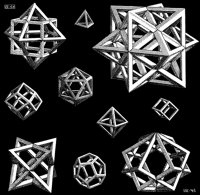
Federation Square. This building in Melbourne uses the pinwheel tiling as a design motif. Thanks to Khalad Karim for identifying it. Photos by Dick Hess, scanned by Ed Pegg Jr. See this Flickr photopool for many more photos.
Triangular polyhex tilings. What is the smallest equilateral triangle that can be tiled by a given polyhex?
Triangulated pig. M. Bern, Xerox.
Triangulating 3-dimensional polygons. This is always possible (with exponentially many Steiner points) if the polygon is unknotted, but NP-complete if no Steiner points are allowed. The proof uses gadgets in which quadrilaterals are stacked like Pringles to form wires.
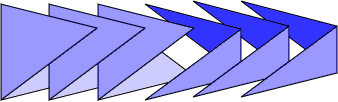
Triangulation numbers. These classify the geometric structure of viruses. Many viruses are shaped as simplicial polyhedra consisting of 12 symmetrically placed degree five vertices and more degree six vertices; the number represents the distance between degree five vertices.
Triangulations and arrangements. Two lectures by Godfried Toussaint, transcribed by Laura Anderson and Peter Yamamoto. I only have the lecture on triangulations.
Triangulations with many different areas. Eddie Grove asks for a function t(n) such that any n-vertex convex polygon has a triangulation with at least t(n) distinct triangle areas, and also discusses a special case in which the vertices are points in a lattice.
Triply orthogonal surfaces, Matthias Weber.
Trisecting an angle with origami. Julie Rehmeyer, MathTrek.
The trouble with five. Craig Kaplan explains why five-fold symmetry doesn't work in regular plane tilings, but does work for the Penrose tiling.
true_tile mailing list for discussion of Euclidean and non-Euclidean tilings.
Truncated icosahedral symmetry. Explains why you might want to use a machined aluminum buckyball as a gravity-wave detector...
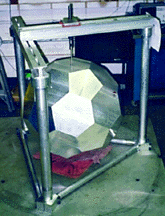
Truncated Nano-Octahedron. Ned Seeman makes polyhedra out of DNA molecules.
Truncated Octahedra. Hop David has a nice picture of Coxeter's regular sponge {6,4|4}, formed by leaving out the square faces from a tiling of space by truncated octahedra.
Truncated Trickery: Truncatering. Some truncation relations among the Platonic solids and their friends.
Lun-Yi Tsai paints fine art of foliatied 3-manifolds, differentiable atlases, and other topological structures.
Tune's polyhedron models. Sierpinski octahedra, stellated icosahedra, interlocking zonohedron-dissection puzzles, and more.
Turkey stuffing. A cube dissection puzzle from IBM research.
Tuvel's Polyhedra Page and Tuvel's Hyperdimensional Page. Information and images on universal polyhedra and higher dimensional polytopes.
27 lines on the Clebsch cubic, Matthias Weber.
Two-distance sets. Timothy Murphy and others discuss how many points one can have in an n-dimensional set, so that there are only two distinct interpoint distances. The correct answer turns out to be n2/2 + O(n). This talk abstract by Petr Lisonek (and paper in JCTA 77 (1997) 318-338) describe some related results.
270-strut tensegrity sphere. Jim Leftwich makes polyhedra out of dowels and hairbands.
Two-three-seven tiling of the hyperbolic plane with lines that connect to give a fiery appearance. From the Geometry Center archives.
Typeface Venus, Circle Marilyn, and Bubble Mona. village9991 uses quadtrees and superellipses to make abstract mosaics of famous faces.
Tysen loves hexagons. And supplies ascii, powerpoint, and png graphics for several styles of hexagonal grid graph paper.
Ukrainian Easter Egg. This zonohedron, computed by a Mathematica notebook I wrote, provides a lower bound for the complexity of the set of centroids of points with approximate weights.
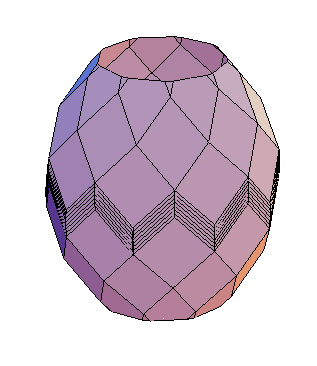
Unbalanced anisohedral tiling. Joseph Myers and John Berglund find a polyhex that must be placed two different ways in a tiling of a plane, such that one placement occurs twice as often as the other.
Unbeatable Tetris. Java demonstration that this tetromino-packing game is a forced win for the side dealing the tetrominoes.
Unfolding convex polytopes. From Jeff Erickson's geometry pages.
Unfolding dodecahedron animation, Rick Mabry.
Unfolding polyhedra. A common way of making models of polyhedra is to unfold the faces into a planar pattern, cut the pattern out of paper, and fold it back up. Is this always possible?
Unfolding convex polyhedra. Catherine Schevon discusses whether it is always possible to cut a convex polyhedron's edges so its boundary unfolds into a simple planar polygon. Dave Rusin's known math pages include another article by J. O'Rourke on the same problem.
Unfolding some classes of orthogonal polyhedra, Biedl, Demaine, Demaine, Lubiw, Overmars, O'Rourke, Robbins, and Whitesides, CCCG 1998.
Unfolding the tesseract. Peter Turney lists the 261 polycubes that can be folded in four dimensions to form the surface of a hypercube, and provides animations of the unfolding process.
Unfurling crinkly shapes. Science News discusses a recent result of Demaine, Connelly, and Rote, that any nonconvex planar polygon can be continuously unfolded into convex position.
The uniform net (10,3)-a. An interesting crystal structure formed by packing square and octagonal helices.
Uniform polychora. A somewhat generalized definition of 4d polytopes, investigated and classified by J. Bowers, the polyhedron dude. See also the dude's pages on 4d polytwisters and 3d uniform polyhedron nomenclature.
Uniform polyhedra computed by Roman Maeder using a Mathematica implementation of a method of Zvi Har'El. Maeder also includes separately a picture of the 20 convex uniform polyhedra, and descriptions of the 59 stellations of the icosahedra.
Uniform polyhedra in POV-ray format, by Russell Towle.
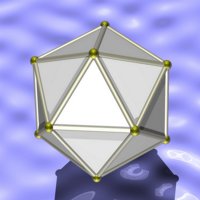
Uniform polyhedra, R. Morris. Rotatable 3d java view of these polyhedra.
An uninscribable 4-regular polyhedron. This shape can not be drawn with all its vertices on a single sphere.
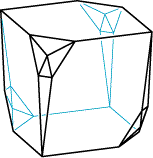
Uniqueness of focal points. A focal point (aka equichord) in a star-shaped curve is a point such that all chords through the point have the same length. Noam Elkies asks whether it is possible to have more than one focal point, and Curtis McMullen discusses a generalization to non-star-shaped curves. This problem has recently been put to rest by Marek Rychlik.
Universal coverage constants. What is the minimum area figure of a given type that covers all unit-diameter sets? Part of Mathsoft's collection of mathematical constants.
Unreal project. Non-photorealistic rendering of mathematical objects, Amenta, Duvall, and Rowley. Here's another unreal page.
Unsolved problems. Naoki Sato lists several conundrums from elementary geometry and number theory.
Variations of Uniform Polyhedra, Vince Matsko.
Vasarely Design. Hana Bizek makes geometric sculptures from Rubik's cubes.
Vegreville, Alberta, home of the world's largest easter egg. Designed by Ron Resch, based on a technique he patented for folding paper or other flat construction materials into flexible surfaces.

A Venn diagram made from five congruent ellipses. From F. Ruskey's Combinatorial Object Server.
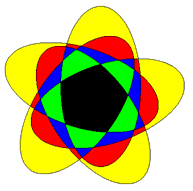
Virtual Image, makers of CD-ROMS of ray-traced mathematical animation.
Vision test. Can you spot the hidden glide reflection symmetry lurking in (the infinite continuation of) this pattern?

Visual math, the mathematical art of M. C. Escher.
Visual Mathematics, journal and exhibitions relating art and math.
Visual techniques for computing polyhedral volumes. T. V. Raman and M. S. Krishnamoorthy use Zome-based ideas to derive simple expressions for the volumes of the Platonic solids and related shapes.
Visualization of a hyperbolic universe, Martin Bucher.
Visualising fractals in 3D. Sierpinski tetrahedron in Stonehenge, and a Menger sponge.
Visualizing the hypersphere via 3d slices, and other four-dimensional thoughts by Jeff Fuquay.
Visualization of the Carrillo-Lipman Polytope. Geometry arising from the simultaneous comparison of multiple DNA or protein sequences.
The Vitruvian Man. Connections between Leonardo's polygon-inscribed human figure and sacred temple geometry.
Volume of a torus. Paul Kunkel describes a simple and intuitive way of finding the formula for a torus's volume by relating it to a cylinder.
Volumes in synergetics. Volumes of various regular and semi-regular polyhedra, scaled according to inscribed tetrahedra.
Volumes of pieces of a dodecahedron. David Epstein (not me!) wonders why parallel slices through the layers of vertices of a dodecahedron produce equal-volume chunks.
Voronoi Art. Scott Sona Snibbe uses a retro-reflective floor to display the Voronoi diagram of people walking on it, exploring notions of personal space and individual-group relations. Additional Voronoi-based art is included in his dynamic systems series.
Voronoi diagram of a Penrose tiling (rhomb version), Cliff Reiter.
Voronoi diagrams at the Milwaukee Art Museum. Scott Snibbe's artwork Boundary Functions, as blogged by Quomodumque.
Voronoi diagrams of lattices. Greg Kuperberg discusses an algorithm for constructing the Voronoi cells in a planar lattice of points. This problem is closely related to some important number theory: Euclid's algorithm for integer GCD's, continued fractions, and good approximations of real numbers by rationals. Higher-dimensional generalizations (in which the Voronoi cells form zonotopes) are much harder -- one can find a basis of short vectors using the well-known LLL algorithm, but this doesn't necessarily find the vectors corresponding to Voronoi adjacencies. (In fact, according to Senechal's Quasicrystals and Geometry, although the set of Voronoi adjacencies of any lattice generates the lattice, it's not known whether this set always contains a basis.)
The Voronoi Game. Description, articles, references, and demonstration applet on problems of competitive facility location, where two players place sites in hopes of being nearest to as much area as possible. See also Crispy's Voronoi game applet and Dennis Shasha's Voronoi game page.
vZome zometool design software for OS X and Windows. (Warning, web site may be down on off-hours.)
Wallpaper groups. An illustrated guide to the 17 planar symmetry patterns. See also Xah Lee's wallpaper group page.
Wallpaper patterns, R. Morris. Kaleidoscope-like Java applet for making and transforming symmetric tilings out of uploaded photos.
Walt's toy box. Walt Venables collects geometric toys, and uses them to help design geodesic domes.
The Water Cube swimming venue at the 2008 Beijing Olympics uses the Weaire-Phelan foam (a partition of 3d space into equal-volume cells with the minimum known surface area per unit volume) as the basis of its structure.
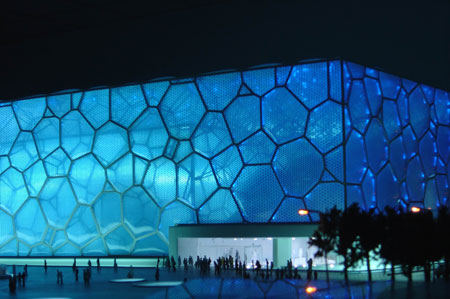
Waterman polyhedra, formed from the convex hulls of centers of points near the origin in an alternating lattice. See also Paul Bourke's Waterman Polyhedron page.
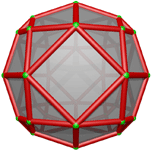
Matthias Weber's gallery of ray-traced mathematical objects, such as minimal surfaces floating in ponds.
Wei and Stan's Puzzle Selections, Key Press.
Fr. Magnus Wenninger, OSB, mathematician, builder of polyhedra.
Westside Impressions sells Escher T-shirts.
What can we measure? A gentle introduction to geometric measure theory.
What do you call a partially truncated rhombic dodecahedron? Doug Zare wants to know.

What happens when you connect uniformly spaced but not dyadic rational points along the Peano spacefilling curve? R. W. Gosper illustrates the results.

What is David Fowler making a Sierpinski tetrahedron out of? It looks like toothpicks and marshmallows, or maybe pieces of styrofoam peanuts.
What to make with golf balls? Dale Seymour chooses a Sierpinski triangle and Sierpinski tetrahedron.
When can a polygon fold to a polytope? A. Lubiw and J. O'Rourke describe algorithms for finding the folds that turn an unfolded paper model of a polyhedron into the polyhedron itself. It turns out that the familiar cross hexomino pattern for folding cubes can also be used to fold three other polyhedra with four, five, and eight sides.
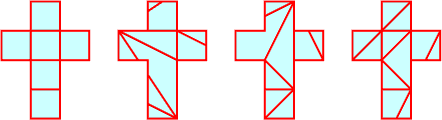
Whimsical rendering of a 4-cube. Rick Mabry animates a 3d projection that has a nice symmetrical 2d projection.
Why doesn't Pick's theorem generalize? One can compute the volume of a two-dimensional polygon with integer coordinates by counting the number of integer points in it and on its boundary, but this doesn't work in higher dimensions.
Why "snub cube"? John Conway provides a lesson on polyhedron nomenclature and etymology. From the geometry.research archives.
Wingeom, freeware Windows geometric construction software.
Wonders of Ancient Greek Mathematics, T. Reluga. This term paper for a course on Greek science includes sections on the three classical problems, the Pythagorean theorem, the golden ratio, and the Archimedean spiral.
Wooden ball-and-stick models of Archimedean solids, offered for sale by Dr. B's Science Basics.
Wooden polyhedra from Japan (but with English explanations). And more, in Japanese.
Woolly thoughts, mathematical knitwear.
A word problem. Group theoretic mathematics for determining whether a polygon formed out of hexagons can be dissected into three-hexagon triangles, or whether a polygon formed out of squares can be dissected into restricted-orientation triominoes.
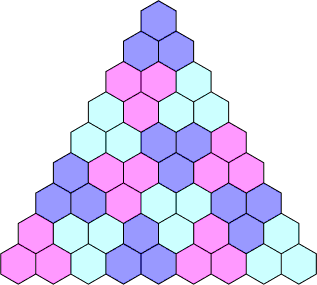
The world of hyperbolic geometry, Colleen Robles.
The world's largest icosahedron. Jason Rosenfeld makes polyhedra out of ten foot poles and shark fishing line.
Worm in a box. Emo Welzl proves that every curve of length pi can be contained in a unit area rectangle.
Joseph Wu's origami page contains many pointers to origami in general.
WWW spirograph. Fill in a form to specify radii, and generate pictures by rolling one circle around another. For more pictures of cycloids, nephroids, trochoids, and related spirograph shapes, see David Joyce's Little Gallery of Roulettes. Anu Garg has implemented spirographs in Java.
Xominoes. Livio Zucca finds a set of markings for the edges of a square that lead to exactly 100 possible tiles, and asks how to fit them into a 10x10 grid.
Yantram sacred art toolbox. Software for creating various kinds of symmetric fractal mandala.
yukiToy. Shockwave plugin software for pushing around a few reddish spheres in your browser window. But what exactly is the point? (They're spheres, they don't have one, I guess.)
Zef Damen Crop Circle Reconstructions. What is the geometry underlying the construction of these large-scale patterns?
Al Zimmerman's circle-packing contest. Cash prizes for finding the best packing of circles with radii in arithmetic progression into a single larger circle.
Zometool. The 31-zone structural system for constructing "mathematical models, from tilings to hyperspace projections, as well as molecular models of quasicrystals and fullerenes, and architectural space frame structures".
Zometool truncated icosahedron image from the A2Z science and learning store catalog. This looks to me like a raytrace rather than a real model.
Zonohedra and cubic partial cubes. Connecting the geometric problem of classifying simplicial line arrangements to the graph-theoretic one of finding regular graphs that can be isometrically embedded on a cube.
Zonohedra and zonohedrification. From George Hart's virtual polyhedron collection.
Zonohedron. From Eric Weisstein's treasure trove of mathematics.
Zonohedra and zonotopes. These centrally symmetric polyhedra provide another way of understanding the combinatorics of line arrangements.
Zonohedron Beta. A flexible polyhedron model made by Bathsheba Grossman out of aluminum, stainless steel, and brass (bronze optional). Also see the rest of Grossman's geometric sculpture.
Zonohedron generated by 30 vectors in a circle, and another generated by 100 random vectors, Paul Heckbert, CMU. As a recent article in The Mathematica Journal explains, the first kind of shape converges to a solid of revolution of a sine curve. The second clearly converges to a sphere but Heckbert's example looks more like a space potato.
Zonotiles. Russell Towle investigates tilings of zonogons (centrally symmetric polygons) by smaller zonogons, and their relation to line arrangements, with an implementation in Mathematica.
Zonotopes. Helena Verrill wonders in how many ways one can decompose a polygon into parallelograms. The answer turns out to be equivalent to certain problems of counting pseudo-line arrangements.
Frank Zubek's Elusive Cube. Magnetic tetrahedra connect to form dissections of cubes and many other shapes.